Archive for the ‘neurotheology’ Category

Epigenetic Enlightenment

Saturday, July 19th, 2008

“Life’s experiences add molecular switches to the genes that control our brain activity,” is the subhead on an article in a recent issue of SciAm Mind. The article presents the new field known as epigenetics, which holds that experience can cause chemical changes that boost or depress the expression of certain genes.

This is a rich potential mechanism for describing interaction of nature and nurture in general, but in particular the progress of spiritual development associated with ongoing practices such as Zen meditation. Simply put, meditation practice could have chemical effects such as attaching methyl groups to genes, which quiets the gene by interfering with the ability of the RNA-based transcription mechanism. Or it could attach acetyl groups with the opposite effect, letting the genes express themselves more easily.

This is an intriguing supplement or alternative to other explanations of the long-term effects of meditation, such as neuroplasticity, but what is the gene, or genes, in question? Such a hypothesis will be a prerequisite for experimental design in this field.

Image of chromatin created by Nicolas Bouvier; courtesy of Genevieve Almouzni, Curie Institute, Paris, France.

The Neural Buddhists: Neurotheology in the NYT

Monday, May 19th, 2008

The New York Times published a surprising article last week on the topic of meta-neurotheology: the context and evolution of the social discussion about neurotheology. Author David Brooks points out the huge impact that the neuroscience revolution is having and will have on our culture’s views of God, religion, and science. His main point: the direction we will take as the discussion unfolds is not towards atheism and pure materialism, but rather something he calls neural Buddhism: “new movements that emphasize self-transcendence”, based on beliefs in a dynamic self, shared morals, elevated experience, and a new concept of God.

(more…)

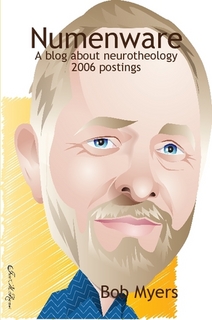
Numenware–the book

Wednesday, January 9th, 2008

2006 postings to Numenware are now available in book form for the low, low price of $19.95. What better belated Christmas present for your loved one or even yourself to read in the tub.

From the intro:

2006 was the year with the greatest density of neurotheological content on the blog, and these articles, taken as a whole, would I hope represent a meaningfully significant, if somewhat quirky, overview of the field.

Loyal readers of Numenware who read posts as they went up may have missed the discussion in the comments section, many of which are extremely informative. These comments have been included in the book, typos and all.

Buy Numenware 2006 from Lulu.com now. 140 pp., with an extensive (10 page) index. Digital version available for three bucks and change.

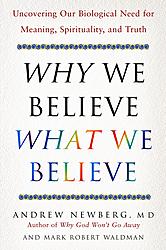
Why I Believe “Why We Believe” is Mush

Sunday, January 6th, 2008

The word must be out about what Daddy’s interested in because under the tree for me at Christmas-time were two, count ‘em, two books by Andrew Newberg, MD, namely “Why We Believe What We Believe” and “Why God Won’t Go Away”. Picked up the first one and started in on Chapter 1, “The Power of Belief”. The first story was about a guy for whom a cancer drug worked when he believed it would and didn’t when he didn’t. That seems a little off-topic–the book’s supposed to be about “Why We Believe”, not “What Belief Does”, but hey, let’s give Andy the benefit of the doubt. But then he undercuts his own case by quoting estimates that such spontaneous remissions occur only one in 3,000 or perhaps as few as 100,000 medical cases. And that’s even before you’ve eliminated spontaneous remissions not associated with “belief”. Why exactly are we supposed to be so concerned with something that might, or might not, be responsible for healing some infinitesimally tiny fraction of sick people?

(more…)

Sagan on neurotheology

Sunday, December 10th, 2006

I’m having huge fun reading Carl Sagan’s The Varieties of Scientific Experience. These are the Gifford lectures (website) he gave in 1985. Even after more than two decades, this is one of the most cogent, engaging, lucid, approachable, modest, insightful, and encompassing approaches I have seen to the science vs. religion debate.

He summarizes the key neurotheological issues far better than I could ever hope to:

People have religious experiences. No question about it. They have them world-wide, and there are some interesting similarities in the religious experiences tha are had worldwoide. They are powerful, emotionally extremely convincing, and they often lead to people reforming their lives and doing good works, although the opposite also happens…But the question is, can any such experience provide other than anecdotal evidence of the existence of God or gods? … Large numbers of people can have experiences that can be profound and movnig and still not correspond to anything like an exact sense of external reality.

I note also that religious experiences can be brought on by specific molecules. There are many cultures that consciously imbibe or ingest these molecules in order to bring on a religious experience. It’s a very long list of materials. This suggests that there is some molecular basis for the religious experience and that it need not correspond to some external reality.

Let’s say there’s a molecule that produces a religious experience, whatever the religious experience is. How does that come about? Virtually every time someone takes that molecule, he or she has a religious experience. Does that not suggest that there is a natural molecule that the body produces whose function it is to produce religious experiences, at least on occasion? What could that molecule be like? Let’s give it a name, since nobody’s discovered it yet, and of course it may not exist—let’s call it “theophorin”.

What could the selective advantage of a theophorin be? How would it come about? Why would it be there? Well, what is the nature of the experience? The nature of the experience has, as I say, many different aspects. But one uniform aspect of it is an intense feeling of awe and humility before a power vastly greater than ourselves. And that sounds to me very much like a dominance-hierarchy molecule or part of a suite of molecules whose funcdtion it is to fit us into the dominance hierarchives.

I think there is as much difference between the religious experience and the bureaucratic religions as there is, say, between sex with love and sex without love. And of course humans have added something profound and beautiful in both cases to the molecular reflex. Perhaps this account will sound tasteless or unpalatable to many, and if so I apologize. But if we treat the question of the origin of religion and the religious experience as a scientific question, then we must ask, “What essential aspects of the religious experience are left out by this hypothesis?” and note that it is at least in principle testable by finding the theophorin, and you could then of course see a large number of controlled experiments to test that out in great detail.

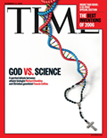
TIME magazine on Science vs. God

Tuesday, November 21st, 2006

TIME magazine had an immensely stupid article called “God vs. Science” on the cover of its Nov. 13, 2006 issue. They couldn’t even decide who the combatants were in this supposed duel. Right off the bat, they confuse science with “Darwinism” and religion with “God”. Then they make the ludicrous suggestion that science might not be able to “withstand the criticisms” of Christians.

The article does make the somewhat useful point, however, that the “debate” may be becoming more polarized (as in my opinion it should), although there are also now more “informed conciliators”, by which Time apparently means people who believe in magic but have letters like PhD after their names.

Unfortunately, Time chose not to actually report further on the subject—which encompasses minor topics such as, oh, how a scientific explanation of religious belief and experience could affect the history of the world, including Islamic terrorism. Instead, it printed a painful dialog between Richard Dawkins and Francis Collins (Wikipedia), eminent genome decoder and devout Christian.

Painful because of how stupid Collins sounds. He starts off by rolling out the tired old theory about God setting the machine in motion, “activating evolution” at the moment of creation of the universe (or at least all parts of it other than Himself), but in this contorted version apparently having foreknowledge of everything including the ridiculous discussion itself. Somehow, this is supposed to reconcile God’s omniscience with free will. Of course, God didn’t want to make things too easy for us, so he hid all the clues to His existence—which is why Dawkins can’t see them! God tweaked the universal physical constants so we could exist (what were they set to before?). The existence of God satisifies Occam’s razor, since it’s such a simple explanation—God made everything! Collins accuses Dawkins of holding an “impoverished view of the kinds of questions we humans can ask, such as ‘Is there a God?’”. But if by this he means Dawkins thinks such questions are invalid, he’s just wrong. Of course Dawkins’s view is that humans can ask such questions. He simply answers them in the negative.

But wait! Collins now zigzags and says God, instead of being the Guy that sets up the model train layout and twiddles the knobs, is actually “something incredibly grand and incomprehensible and beyond our present understanding.” But if that were the case, how could we understand Him fiddling with the gravitational constant or setting evolution in motion? And then suddenly he has God not just setting things up at the beginning, but micromanaging miracles like the virgin birth, because “it was a particularly significant moment for him to do so.” Collins is also apparently ignorant of all the recent research on human ethics and altruism, continuing to flog the old notion that only God can make us ethical.

Collins concludes:

…there are answers that science isn’t able to provide about the natural world—the questions about why instead of the questions about how. I’m interested in the whys. I find many of those answers in the spiritual realm. That in no way compromises my ability to think rigorously as a scientist.

So now, finally, God is reduced to the concept of all the Unknown Stuff Out There. And it doesn’t compromise Collins’ ability to think rigorously that he believes in the resurrection (but not, of course, in the creation story in Genesis; which he says cannot be interpreted “narrowly”, was not “intended as a science textbook”, and is actually “very consistent with the Big Bang”).

Collins asserts that God provides the answer to the “why” questions, presumably of the “why are we here” variety. But he never explains what those answers are, how there could be such answers, or what the nature of those answers might be.

Collins should have followed the advice he quotes St. Augustine as giving, warning against a very narrow perspective that will put our faith at risk of looking ridiculous. If he had, he would have skipped this whole discussion. That would have let Time do what it should have in the first place, which is to actually report on the issue.

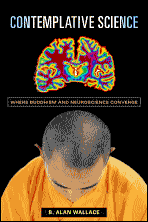
Book review: Contemplative Science

Saturday, November 18th, 2006

Contemplative Science: Where Buddhism and Neuroscience Converge is B. Alan Wallace’s new book. It’s packed full of challenging insights.

For instance, I hadn’t realized that:

  • It was scientific materialism that was responsible for the death of millions of people under Hitler, Mao and Stalin.
  • Scientists, the majority of whom are materialists and reductionists, adamantly refuse to consider the life of the mind. (The broad-ranging field of psychology apparently doesn’t count. Anyway, a lot of psychologists used to be behavioralists a long time ago.)
  • Scientists don’t know the first thing about reality because they don’t even know what consciousness is. (Just like medieval scientists also could not explain “vapors” and “humors” and the “ether”.)
  • Scientific materialism strips our lives of meaning.
  • It also removes our free will. (And that’s one thing I insist on having.)
  • It undermines our sense of moral responsibility.
  • The more progress is made in physics, the more it proves we don’t know anything at all.
  • The fact that this scientific materialism stuff just doesn’t cut it is proved by the 80% of Americans that believe in ghosts and virgin births.
  • Voters supported Bush in 2004 because of his moral values, and not Kerry because he appeared to “stand for so little”.
  • But still, we need to find a “fresh, integrative perspective” to reconcile these two “traditions”, even though “scientific materialism is a modern kind of nature religion or neoanimism, whic had innumerable precedents int he preliterate history of humanity”.
  • The First Amendment’s establishment clause has been interpreted in an overly broad way by generations of judges.

And all that’s only from one chapter. Maybe elsewhere in the book there’s some good stuff about Buddhism, since that’s in the book’s subtitle? Sorry. We find nothing more than a mind-numbing, academic analysis of Tibetan Buddhist cosmology, that has nothing to do with neuroscience or science of any kind. (This chapter, like most (all?) of the others, apparently was cut-and-pasted from some earlier publication to fill out page count.) Maybe we’ll find out something about Zen and neuroscience? Sorry. Zen is not mentioned in the book once. Maybe we’ll learn about lots of neuroscientific research into meditation? Sorry. Wallace barely mentions the names of leading researchers and doesn’t even bother to summarize their results. Richard Davidson appears just once, in a parenthetical reference claiming that his work “shows that the idol of the brain has been toppled by empirical evidence.” Crick and Koch are brought up only to blithely accuse them of reducing consciousness to whatever science has the abililty to study, even as Wallace claims that scientists refuse to study consciousness. Perhaps we will learn about scientific theories of reincarnation memories? Sorry. We’re left with a couple of references to studies of kids who remembered past lives.

There is much that is simply stupid in this book, repetitive, superficial, or irrelevant. What is not stupid is basically wrong or at best wildly misinformed. Overall, one gets the impression that Wallace would rather be living in medieval Tibet than 21st century America; back then, there were no evil scientists and no pesky walls between the secular and spiritual.

Religion on the Brain: California ScienCenter event

Sunday, November 5th, 2006

The first event in the California ScienCenter’s “Science Matters” series was Religion on the Brain, held on November 4, 2006. It was attended by a thousand people. What an outpouring of interest in the biology of religion! What were these people looking for? Judging from the questions from the audience, some appeared to be scientists, but most were “seekers” in the informal sense—still trying to figure out what all this means. I doubt they were satisfied.

The selection of panelists looked promising: VS Ramachandran, as well as Joan Roughgarden (pictured) from Stanford (author of “Evolution’s Rainbow”), Michael Schermer (Wikipedia) of the Skeptics Society, and Warren Brown (link), a psychologist and writer on science and religion issues.

Unfortunately, this panel ended up generating neither much heat nor light. VS was given a brief 15 minutes to present some basic research on the brain and religion, then Conan Nolan (bio), a reporter who served as the moderator, dove right into a series of unstructured questions.

Schermer, with whom I’m not familiar, is an agnostic, but apparently adopts a very simplified sociological/anthropological view of the origins of religion. The narrator failed to ask him to clarify his views on the differences between a brain-based view of religion and a societally-based one (or, to state the question another way, which aspects of religion might be brain-based and which societally-based).

We never managed to figure out what Joan Roughgarden’s agenda was, since all we heard from her were answers to ad hoc questions. Judging from those, she seems to be missing a few marbles. She claims that neurobiology (I guess she meant neuroimaging) is over-resolving. In other words, it’s seeing stuff that’s not really there? Or the stuff it’s seeing is random, or doesn’t matter? She made the incredibly odd analogy that having a religious experience is like eating a chocolate bar, and of course both affect your brain. Does it really take a PhD to figure out all the ways that eating a piece of chocolate is distinct from thinking you’ve seen God? Then she made the startling asserting that there’s nothing really extraordinary about the relationships between the brain and God. One is left to assume—she never bothered to tell us—that she thinks that God is out there somewhere and we use our brains to perceive Her in the same way we use them to perceive a butterfly. If she believes that, why did she bother to accept the invitation to the panel discussion?

We know from the blurb on her new book “Evolution and Christian Faith” that she’s “an evolutionary biologist and a Christian,” and the book “offers an elegant, deeply satisfying reconciliation of the theory of evolution and the wisdom of the Bible.” She has “scoured the Bible and scanned the natural world, finding examples time and again, not of conflict, but of harmony.” In a way I’d sort of like to read this book, but unfortunately I have to draw the line somewhere. Her previous book, “Darwin’s Rainbow,” which discusses evolution and sexual diversity, might be more fun.

Nor was Warren Brown, from Fuller Theological Seminary, given any more of a chance to say what he thought, which is apparently something about of the integration of neuroscience and Christian faith. He has edited a book called Whatever Happened to the Soul, which is said to present a nonreductive physicalist Christian anthropology, whatever that might be.

What was missing at this forum was your basic unapologetic reductionist. Ramachandran doesn’t fill the bill: he resolutely refuses to take a stand on whether God really exists. He even, in answer to a softball question about whether a future God pill would or would not give rise to ethical issues, refused to answer on the grounds that that was not a scientific question.

Perhaps in the future such worthy events can be better planned, better structured, and better executed, perhaps with the participation of a leading blogger about religion and the brain. :-)

Book Review: The God Delusion

Tuesday, October 31st, 2006

Richard Dawkins’ The God Delusion (Amazon) is a snappy, readable book about, basically, how God doesn’t exist (or exists only with vanishingly low probability). Greater minds than my own have already reviewed the book (NYT) and pronounced it brilliant or stupid or flawed or whatever. Here I’ll confine myself to neurotheological and Buddhist aspects.

The most basic problem with this book is that it completely fails to take into account the connection between religion and any process of personal development and/or the biological “correlates” of that process. To the extent religion is to some extent a highly corrupted version of meaningful, biologically-based insights about how to be happier, many of Dawkins’ points would need to be modified or recast.

On p. 37 Dawkins claims he will not be “concerned at all with other religions such as Buddhism or Confucianism. Indeed, there is something to be said for treating these not as religions at all but as ethical systems of philosophies of life.” That’s a great distinction to be made, but at the same time Buddhism and Western monotheism are similar in that they are both socially dominant systems of belief and thought, and rather than arbitrarily excluding one, why doesn’t Dawkins incorporate Buddhism into his thinking as a way to better define the topological contours of religion and religious behavior?

Surprisingly for a biologist, Dawkins mentions “neurotheology” only once, in a dismissive tone. On pp. 168-169, he says:

The proximate cause of religion might be hyperactivity in a particular node of the brain. I shall not pursue the neurological idea os a ‘god centre’ int he brain because I am not concerned here with proximate questions…If neuroscientists find a ‘god centre’ in the brain, Darwinian scientists like me will still want to understand the natural selection pressure that favoured it.

This seems like a particular devious way to dodge neurotheological questions. Perhaps the existence of a ‘god centre’ (more accurately, religiously-connected neural circuitry or structures) can be considered a “proximate” issue, but attempting to understanding it, rather than simply ignoring it, could help in grasping the “ultimate” cause, which for Dawkins is the Darwinian one. Would Dawkins focus on the evolutionary reason for the existence of the visual faculty without bothering to learn about the structure of the eye?

The cutest idea in this book, new at least to me, is that religion survives due an evolutionary tendency for children to believe what their parents say. This provides a scenario for a gradual decline over decades and centuries of Bible-thumping religions, as in each generation some percentage of believers, however, small, discard the religion of their parents and produce non-religious kids, as I did—to the extent that one day my oldest son came home from elementary school and asked me, “Daddy, who is this guy they were talking about in class today called ‘Cheeses’?”. Compare this to Dennett in Breaking the Spell, who provides no roadmap other than that people will or should stop believing just because he thinks religion is so stupid.

Note: to counter comment spam, hyperlinks in comments have now been disabled. To include a link in comments, please simply specify the URL, and the reader will have to cut and paste.

Book Review: Zen-Brain Reflections

Saturday, October 21st, 2006

Zen-Brain Reflections is James H. Austin’s follow-up to his definitive Zen and the Brain. As always, Austin is learned and thorough. The book has great value. It is almost certainly the best survey of research in the field of neurotheology, or perhaps we should use Davidson’s term “contemplative neuroscience.” But ultimately it’s closer to a set of research notes than a book. It presents tantalizing ideas and intriuging possibilities, but few hypotheses or frameworks. We’re left with a lot of information, but little understanding.

According to the description:

Zen-Brain Reflections takes up where the earlier book left off. It addresses such questions as: can neuroimaging studies localize the sites where our notions of self arise? How can the latest brain imaging methods monitor meditators more effectively? How do long years of meditative training plus brief enlightened states produce pivotal transformations in the physiology of the brain? Austin reviews the latest studies on the amygdala, frontotemporal interactions, and paralimbic extensions of the limbic system. He then explores different states of consciousness, both the early superficial absorptions and the later, major “peak experiences.”