Archive for the ‘Uncategorized’ Category

The Tale of Nathaniel the Toad

Sunday, April 6th, 2008

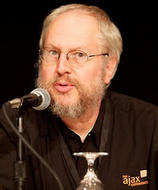
Douglas Crockford is the oracle of Javascript and holds the right position on Javascript 2.0. He also writes the quirky Department of Style blog. Here’s today’s post:

Once upon a time there was a small toad named Nathaniel. Nathaniel was despised by everyone who knew him. Not because he was a toad, or because he pulled the wings and legs off of flies before he ate them, but because he could not be trusted.

One day at the forest tavern, where all the small forest creatures went nightly to get drunk, Nathaniel announced that he was never going to pay back the money he had borrowed from his little woodland friends. And he borrowed large sums of money from just about everyone.

So they killed him. And then they pulled his legs and arms off and ate him.

Sakiko’s new blog

Saturday, March 22nd, 2008

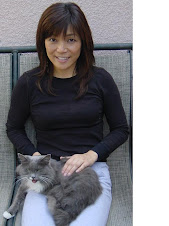
Sakiko has started a blog at http://sakikokimura.blogspot.com. Expect lots of cat pictures.

Nancy’s Good-bye to Uncle Bill

Saturday, October 20th, 2007

I wrote about my Uncle Bill’s recent death here. Unfortunately, I have no picture of Uncle Bill to grace this post with. Here’s my sister Nancy’s remembrance, which she kindly consented to let me post here.

(more…)

Goodbye, Uncle Bill

Tuesday, October 2nd, 2007

My Uncle Bill died in his sleep last week at the nursing home in Lewiston, ID where he was spending his final days. He’s been cremated and his ashes will be scattered on the Alaskan ocean where he fished for salmon in his second career, alongside those of his late first wife.
(more…)

Star Simpson and Ko

Saturday, September 29th, 2007

Star Simpson (picture), the MIT student who was arrested on Sept. 21 at Logan Airport for wearing a circuit board on her sweatshirt (story), went to high school at HPA with my son Ko.

She’s clearly a brilliant student and athlete, but maybe not such a great web designer, judging by her MIT home page (now offline, but still available in Google’s cache).

To set the record straight, technically it was not a printed circuit board but rather a “prototyping board”, as pointed out in this fellow MIT student’s blog. OK, thanks for the clarification.

Bob and Sakiko get married

Saturday, November 18th, 2006

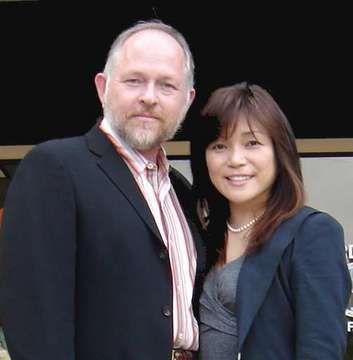
Bob and Sakiko got married on Tuesday, November 14, 2006.

Thanks for your comments

Tuesday, July 18th, 2006

I’d like to thank the readers of Numenware for their insightful comments and the value they add to the blog.

Actually, the greatest number of comments came on an obscure post about a trivial English grammar issue. For some reason, huge numbers of readers from India believed I was offering some kind of English lessons. I wish I could figure out how to monetize these guys!

Next most popular was 34 readers commenting on my post about Charles Shaw’s $2 wine. Must have gotten picked up somewhere. As long as they click on my Google ads, I’m fine.

My post on sushi restaurants near my house generated 24 comments. My favorite was

My two interests are Neurotheology and Sushi and those two roads have guided me to this informative website….

Thought-provoking comments included those on the article Science and Buddhism on craving and suffering and The End of Faith. On my post on Bill O’Reilly: unlikely neurotheology advocate, the actual interviewee who appeared on Bill’s program made a comment. Some of the comments were very personal: on Religious music in your brain, one reader commented:

I am constantly hearing Christmas and religious hymns whenever I am not concentrating on a task. I also hear some old popular songs ‘Tammy’ & “The Bells of St. Mary’s”, “Star Spangled Banner” Every tune is in the same beat of 3/4 time. How do I stop this, it is driving me mad.

No one bothered to comment on one of my favorite posts, God and the brain in your gut, although it got some trackbacks. Nor on Peak experiences on mountain peaks, although it got picked up by Mind Hacks, nor on the article about dried squid entrails. My post about Sanyo: washing machines and global symbiosis yielded a request for a user’s manual for one of their washing machines.

The longest comment, by far, was on my post Book review: Living with the Devil, where Nordron, a Buddhist monk from Dharmasala, gave a thoughtful, detailed Buddhist perspective. Rhawn Joseph himself commented on my post about him and warned me that the picture I was using was wrong (since fixed).

I have been blessed with thoughtful, informative comments which add, I think, to the overall value of the blog, and not too many of them to be overwhelming. Thank you again.

Dogen on visual and auditory perception

Saturday, May 27th, 2006

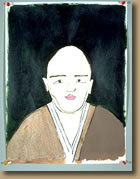
Which of the following two statements is Dogen more likely to have made?
1. We should unite body and mind to see and hear things, because this will allow us to grasp them directly, unlike a reflection in a mirror

2. Striving with body and mind to look at and listen to things may bring us closer to reality but ultimately is not the enlightened model

We are looking at an often-overlooked portion of Genjo Koan, which the overwhelming consensus says is correctly interpreted as (1). But I think it’s (2). How about you?

Let’s start off looking at the Tanahashi/Aitken translation:

When you see forms or hear sounds fully engaging body-and-mind, you grasp things directly. Unlike things and their reflections in the mirror, and unlike the moon and its reflection in the water, when one side is illumined the other side is dark.

To oversimplify, he’s saying that full engaging body-and-mind is good, reflected stuff is bad, and that one side being dark is good again.

But first let’s make some minor stylistic criticisms

  • In the original Dogen repeats “fully engaging body-and mind” with regard to both seeing and hearing, but Tanahashi omits this. All else being equal, we’d prefer to retain such stylistic devices in the original. But it may be more than merely stylistic: Dogen could be using the repetition to indicate excessive exertion..
  • Dogen uses the terms kenshu and choushu for seeing and hearing, the words in question being comprised of the character for “see” and “hear” followed by that for “take”. If Dogen had simply intended “see” and “hear” he would have used the corresponding terms, but instead he makes a point of using compounds with “take” as the second element. In other words, he is emphasizing the perception aspect: “take in sights”, “take in sounds”. This is missing from Tanahashi.
  • In the original, there is a but (J. suredomo) after “grasping things directly”, but Tanahashi has omitted this and instead brought the sentence to a full stop. Again, this may not be a merely stylistic matter; the “but” can easily be read as casting a negative nuance on the “grasping directly.”
  • In the original, it says “moon and water”, but Tanahashi has rendered this as “the moon and its reflection in the water.” It may be OK for him to add “reflection”, but in that case at a minimum it needs to be “the moon and the water [in which it is reflected].”

What other clues do we have about what the sentence might mean?

  • The “fully engaging” part (in Japanese, koshite) reminds of the “setting forth” (J. hakobite) phrasing used a few paragraphs earlier, where Dogen says disapprovingly that “setting forth on your own to practice and illuminate things is delusion”. Actually, “fully engaging” is pretty much of an invention on Tanahashi’s part, trying to make the sentence read better under what he thinks its interpretation is. The dictionary for this character gives “raise”, or “act”. One translator uses “muster”. Many translations, including modern Japanese ones, interpret this as “bring together”, which does have some justification, but this would seem to be another after-the-fact attempt to justify an a priori interpretation.
  • “Body/mind” appears in the immediately following paragraph, the famous one which states that learning the way means learning yourself, and ends by saying that letting yourself be enlightened by all things means casting off body and mind. So it seems odd that Dogen would be telling us here to gear up body and mind to perceive things and then turn around and tell us to cast off body and mind in the very next paragraph.
  • Of course, the moon and water recall the famous analogy further down in the essay, where Dogen says “gaining enlightenment is like the water cradling the moon.” Again, it’s counterintuitive that he would be using the water/moon here in a negative sense, referring to unduly intermediated perception of reality, and then turn around and use it as a beautiful metaphor for enlightenment. (Although eminent commentators such as Nishiari Bokusan, the early 20th century abbot of Eiheiji, say that this is precisely what he is doing. So what do I know.)
  • There is one confusing factor, which is that some versions of the original place this sentence as a continuation of the previous, which talks about how buddhas are not conscious of being so but are nevertheless buddhas and go on being so. Other versions break the portion we are looking at into a new paragraph. If it is a continuation, then it should be talking about what buddhas do. In fact, some translators even make that explicit, rendering this as “Buddhas unite body and mind to see things…”.

But beyond purely textual analysis, we can also think about what Dogen is likely to be saying. Modern neuroscience teaches us that every perception is mediated through a series of neural subsystems. In other words, there is no such thing as “direct” perception, much as we might like to think there was. Even buddhas have optic nerves and a primary visual cortex.

I’m therefore going against the tide and interpreting this paragraph as follows:

Straining with body and mind to take in sights, or straining with body and mind to take in sounds, may get you closer to reality, but this is not the way the mirror reflects things, or the way the moon and the water work. Focusing on one thing, you will lose sight of the others.

Inventions of the year

Saturday, December 31st, 2005

In addition to my many other hats, I’m an inventor. For a bit of year-end diversion, here are three inventions from this year:

1. Magnetic paper money. Place a weak magnetic strip along the narrow edge of a note of currency. This not only allows the money to stick together—instant money clip!—but also lets you stick it on your refrigerator door. In fact, my two US$1 bill prototypes are stuck on my refrigerator door right now.

Amazingly, this seems to not be the subject of any current US patent.

2. Holographic turn signals. Project cars’ turn signals holographically 10 ft. up above the car, so that following cars can see it even if there is another car in-between.

3. Self-announcing wet paint. Using nanoparticle technology, have wet paint automatically display the message “wet paint” over and over. When it dries, the message automatically disappears.

2005 was also the year in which my invention for “microlinking” images on a web page with text was awarded a US patent (see image), within the context of presenting game commentary and educational materials for strategy games such as chess or Go.

Numenware turns six months old

Friday, October 14th, 2005

September marks the sixth month of Numenware, with 85 posts in that period, almost exactly one every two days.

I’d like to take this opportunity to convey my warm thanks to all my readers for their interest and comments (and putting up with my occasional idiosyncratic posts about Japanese things—cured sea cucumber entrails, anyone?—and who knows what else).

Alexa regularly ranks us in the top 100,000 most visited sites on the web, and lists us as the most popular site in the Top > Science > Social Sciences > Psychology > Psychology and Religion category. Technorati also has us close to the top 100,000 and rising. We’re averaging more than 500 visitors per day now and over 2,000 unique visitors per month. We’re getting linked to more and more and show up on major blog search sites, including Yahoo!’s new blog-enhanced news search.

What’s popular? At the top of the list recently are posts about Bhutan’s Tiger’s Lair, Stigmata, Pachacuti as Builder, God and the brain in your gut, and Computational models of neurotheology.

Perhaps readers have noticed the new tag-based index available on the index page, hopefully increasing the site’s browsability. This uses a service from a company called TagCloud.

As we move ahead, I want to make Numenware more interesting and incisive, continue frequent posting, tighten up my posts for those whose blog-reading time is limited, and, most importantly, focus more on ideas and hypotheses as a way to make some initial order out of all the raw material available to us in this fascinating and critically important field of neurotheology.

Your support is deeply appreciated.

And no, I don’t know where the mural shown above comes from. Corbis’ description of it is simply “graffiti painting of man vomiting”.