Incan quipus were spreadsheet roll-ups with department codes?
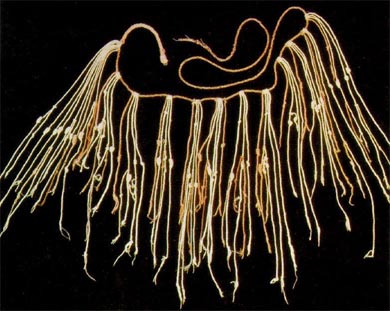
Dr. Gary Urton is one of the foremost scholars of quipu, the Incan system of knotted cords for record-keeping.

(The spelling “quipu” is Spanish. The Quechuan alternative is “khipu” where the “h” indicates an aspirated consonant.)

Dr. Urton is the author of Signs of the Inka Khipu: Binary Coding in the Andean Knotted-String Records, where he unfurled the theory that khipus represent a seven-bit coding system, one that I found utterly unconvincing. In my review on Amazon, I picked apart his theory and compared his approach to discussing an Egyptian tombstone covered with hieroglyphics and spending all your time on categorizing them by shape and size without being able to understand a single one. Dr. Urton responded by saying “…my analogy to binary coding is just that, an analogy that is used to give the reader a general understanding of the type of system that is proposed…the theory of binary coding is put forward in this book in an attempt to find some new way(s) of working with these devices to move us to a new level of analysis and, hopefully, understanding.”

But I’m still not convinced. The theory is an “analogy”? It’s not supposed to be an explanation, but just an “attempt to move to a new level”?

Now the New York Times has reported important new research by Dr. Urton (see also the paper in Nature (subscribers only) and the report in Scientific American):

A new and possibly significant advance in deciphering the quipu system may now have been gained by two Harvard researchers, Gary Urton and Carrie J. Brezine. They believe they may have decoded the first word—a place name—to be found in a quipu, and have also identified what some of the many numbers in the quipu records may be referring to.

Any and all progress in deciphering khipus is welcome. However, looking at these newest findings from Dr. Urton (who has apparently discarded his 7-bit ASCII theory), I am once again underwhelmed.

It’s always been obvious that most khipus record numbers. To simplify a bit, the number 123 would be encoded in a khipu by tying one knot at the top of the cord, leaving a bit of space, tying two knots, leaving more space, then tying three knots, with a special twist indicating this is the last digit. That’s right—the Incas used base-10 arithmetic. The two major questions were: what was being recorded, and did some khipus encode non-numeric information—perhaps even a form of “writing”?

On the first topic, in his latest paper Dr. Urton merely “suspects” and thinks it “likely” that the numerical records are of labor quotas. (The Incan empire was sustained by a system of drafted labor.)

On the second, the “word” found and supposedly “decoded” was simply a 1-1-1 knot which is conjectured to be the name of the town where the khipu was found and presumably created. It’s like finding the number “367” on an Excel spreadsheet and imagining that it must be the code for the department of the guy that created it, and then saying that it’s a “word”.

The NYT thus goes completely overboard when it says that this “discovery” could “resolve a longstanding controversy by establishing that quipus included a writing system. That in turn would help explain the ‘Inca paradox,’ that among states of large size and administrative complexity the Inca empire stands out as the only one that apparently did not invent writing. The paradox would be resolved if indeed the quipu encode a writing system as well as numbers.”

This is absurd. A three-digit city code is not a “writing system”. Dr. Urton says “the use of conventional signs is my definition of writing.” Wrong. Using signs for numbers is not writing.

Another aspect of the new research is the finding that khipus formed a hierarchy, sort of a medieval Andean roll-up. The same numbers were found on two different khipus, and it’s believed that on the first it’s the Excel SUM function adding up all the individual numbers of hours of labor or heads of llama or number of virgins or whatever it was, which was then brought over to the second khipu as a line item to be added up into some kind of regional grand total. That’s interesting, but hardly surprising.

Sadly, we will probably never find the equivalent of the “Rosetta stone” for khipus. It’s essentially equivalent to the problem of someone in the year 2500 trying to unravel record-keeping in 2005 when all they have is 700 Excel expense reports. Urton and other researchers are now entering all extant khipus into computers to find new patterns—but there simply isn’t enough data there to crunch.

23 Responses to “Incan quipus were spreadsheet roll-ups with department codes?”

  1. wasmyth Says:

    Maybe his realization of the failure and recanting of the analogy/theory could be seen as a positive example to lead others in these Intelligent Design times.

  2. paul pawlowski Says:

    I invite you to see Quipu Knot Record

    http://www.muzeumsczytaja.info/index.html

    paul pawlowski
    researcher of inca knot system

  3. Olaf Witkowski, another quipu researcher Says:

    I would like to ask Paul Pawlowski what exactly is the point of his funny online exposition of quipus ? Does he have any clue or interesting point a view to share with us ?

    Thanks for the post, anyway.

  4. paul pawlowski Says:

    Happy New Year!
    Wishing Dr Urton Quipu success!

    I have seen Inca Quipu at the British Museum once.
    Miss Bard of British Museum directed me to Nordenskiold Locke.
    Nordenskiold Quipus in groups of 6-cords. Why in groups of 6 cords?

    Speech is made up of about 40 sounds
    about 400 syllables
    about 30,000 words
    We work 26-A to Z
    What was Inca?
    26-A to Z is in graphic Knots & in mnemonic strands
    26-A to Z works best on 4-mnemonic strands
    Inca Knots on 6 mnemonic strands — Why?

    Our 26-key
    Inca 40-Key?

    Inca recording Key of 40 sounds?
    40-sounds Inca Key divided over 6 cords?
    Longest on 6-cords - 6-turns Inca Quipu Knot?
    If the Knots/strings is 40 sounds — the Quipu must be
    very ancient thing — pre-50m Himalaya?

    I think you would need to be fluent in Inca language
    and have Inca Soul in your heart to work Inca Quipu.
    Just as we are fluent in our language
    and have A to Z Key in our heart

    What about convening Quipu conference?
    Linguists, historians, indigeneous, mathematics,
    informatics zoologists geologists computing
    the scientific community — all would be interested.

    For Lhoba/China mnemonics contact
    Degyi China’s Tibet Magazine
    135 Fuyoujie Street Beijing 100031 China

    Thank you USA
    Good Luck Dr Urton

  5. paul pawlowski Says:

    Miss Bard directed me to Nordenskiold
    My local public library gave me Nordenskiold on loan
    I asked Swedish embassy for permission to reproduce from Nordenskiold
    The embassy sent my request to Nordenskiold museum in Sweden
    Curator replied - he said Erland Nordenskiold was the curator but he died - his book was published more than 50 years ago therefore copyright restriction no longer apply - you may reproduce.
    I made photocopy of Nordenskiold 15 for my own use.

    Looking at Nordenskiold 15 I understood how the Inca knot is done.

    I was working Inca knots for the next 25 years
    I would work Inca knot on any string at hand
    The many-turns became my A to Z
    – and it all started in HM Prison cell Wandsworth.

    I was recording names in knots working A to Z turns.
    My workmates have been asking me to record in knots name of his/her child which I was delighted to do
    My shopfloor mates became my knot-readers.
    Nay! Colin Smith was my quipu proofreader - he was correcting my recording.
    So was my doctor Dr Plant.
    So was Degyi in Beijing (Degyi: “you missed the ‘t’ — the shoelace was not long enough to do the ‘t’)
    I was using more than one Key for recording
    Dr Plant called me once - he couldn’t read my quipu
    No No No! - this one is not A to Z — the Key for this one is Jack and Jill.
    In the New Millennium Year I got an idea - I’ll put Nordenskiold quipus in knots on nylon strings - make Hard Copy of Nordenskiold Inca quipus on nylon string - make it for my own use - to study Inca quipu reproduced in nylon strings

    I applied to my librarian for Nordenskiold again
    This is what I got in reply:

    Dear Mr Pawlowski
    Secret of the Peruvian Quipus: Comparative Ethnographical Studies by Erland Nordenskiold
    With reference to your request for he above item made at Burgess Hill Library, I regret that I have been unable to trace copies for loan in the United Kingdom. However, I understand that this title is avaliable for reference use only at

    Museum of Mankind
    6 Burlington Gardens
    LONDON
    W1X 2EX

    I am sorry that you have been disappointed on this occasion.
    however, I enclose a request voucher which you may use for an alternative item
    Yours sincerely, etc

  6. paul pawlowski Says:

    I made my first quipu in HM Prison cell Wandsworth
    The only thing in my prison cell ’strings’ was the woollen blanket
    I pulled out 26 strands from the blanket and recorded One World in knots
    Link
    India-Forum.Com-1st Anniversary

    When I got out of prison I bought ball of knitting wool and registered trading company
    Scytaios Quipu and Knot Writing Co Ltd
    I wanted to put the woollen quipu on the market

    People sending postcards from Blackpool
    – why not send Blackpool greetings in Knots?

    Blackpool Council had no selling point
    – Try John Lewis - they have stands to let, they advised

    John Lewis manager listened — looked at me doing
    GREETINGS FROM BLACKPOOL in knots and said
    Its a novelty - it may take.
    How much do you expect to take a day?
    Fifteen quid? I said.
    My booble gum man takes 700 a day, said he.
    There was nothing more to be said and I left.

    How come 15 quid?
    Because it takes about two hours to construct a woollen quipu
    Another hour for knotting the message
    Sell 5 quipus a day 3 quid each - 15 quid, I reckoned

    There must be easier way
    I asked Bradford Textile College if woollen quipu could be done on machine
    The instructor took me down to the machine shop - demonstrated string-making - carpet making machine. Carpet making machine would be the closest to make woollen quipu, he said, - and added
    But designers could design machine to do it.
    How much would that cost?
    About £250,000 he said.
    I lost interest marketing the quipu.
    For the next 35 years I was earning my living working in toolmaking
    saving for my retirement
    and researching Quipu for the love of it

  7. paul pawlowski Says:

    I would like quipu researchers to visit Jack and Jill in Knots

    7-turns in Inca Quipu Knot telling us the True Story of Jack and Jill

    http://www.muzeumsczytaja.info/page45.html

    correction
    JACK JILL is knot-mispelled in the webpage
    One 4-turn knot (JACK) should be One-turn knot
    Two 4-turns knots (JILL) should be 3-turn knots

    Would the respected quipu researchers
    correct the knots for me please
    Thank you.

    Links
    http://www.rhymes.org.uk/jack_and_jill.html
    http://www.muzeumsczytaja.info/page45.html

  8. paul pawlowski Says:

    Health & Safety Executive please take notice
    Inca Knots work and safety alert

    We work Inca Knots in nylon strings using tools
    - the scissor - the needle - the knife.

    NEVER use flame on nylon string

    Welder lit cigarette - put the gas lighter in his pocket
    -continued welding - spark burn through his trauser
    - gas lighter exploded blew his leg off.

    Working inca knot we need clean end to put the string through the loop
    – put selotape round the string - scissor-cut through the selotape to obtain clean end - but

    NEVER use flame working nylon string
    - gas lighter explode blow your head off!!!
    NEVER use flame working Inca Knot nylon string.

    NEVER let child work the needle.
    I was working quipu
    – the needle fell on the carpet
    I step on it
    had to go to hospital operation to get it out

    Work Inca Knot safely
    I had quipu stall at a meeting in Haywards Heath.
    Mums with children were at the meeting.
    Children were looking at me making the Inca Knot
    and asking for bit of string

    Child would take the nylon string
    make ABC turns on his finger
    recording his/her name in Inca Knot.

    Always supervise children playing nylon Inca Knot.

  9. paul pawlowski Says:

    6,000 years Inca technology.

    Scholars are telling us the Quipu was in use 6,000 years.
    Lots of technology must have evolved over the centuries.
    How was the Inca doing it?

    Inca using colour code.
    I am not using colour code because I have no need for it
    - but I do tint the string
    to see the Turns better

    I buy 200 metres of nylon string.
    Selotape round the string - cut off the required length
    Needle it through the Main Cold
    Now the Quipu is ready to work

    I do my ABC-turns on Soft Drink Straw.
    All my Knots
    2-turns Knot — 42-turns Knot have been done on Straw.

    Do the Turns on Straw
    - put the end of the string inside the Straw
    -pull the straw out
    pull the ends and I have my Inca Knot
    - not having lost a Turn.

    What tools was the Inca using doing the Knot?
    How was the Inca putting the string through the loop?
    How was the Inca doing the Knot?

    Is somebody looking at footprints of Inca technology?

  10. paul pawlowski Says:

    How was the Inca write/read?

    From L to R
    R to L
    L to R
    R to L
    See footprint Attica script c.550 - 540 BC
    http://www.muzeumsczytaja.info/page37.html

    Sir Kenneth Dover once asked me
    Was the Knot on this side?
    “The Knot is in Egypt hierogryphs together with the loop -Locke

    Did this side get the Knot from the other side?
    Attic Ancestor learn write/read from the other side?

    or was it the other way round
    the other side got the Knot from this side?

    And when?
    this side of 50m Himalaya?
    or the other side?

    Reminiscence
    I came to Britain as teenager just about read/write because of the War.
    In Polish bookshop in Knightsbridge I bought two books
    Pol/Eng dictionary and anthalogy of Polish poetry

    Those were the first books I bought in my life

    The anthalogy said First Polish was written in IX century Zdrowas Mario

    That fired my imagination - How was it before - where did the language came from? OK. First written IX C. - but when First spoken?

    Thats how it started

  11. paul pawlowski Says:

    I read somewhere that Quipu would go with Oral message
    – the runner would carry the Quipu AND Oral message (Locke?)

    But why run with quipu AND Oral message?

    Could the knotted message be different to the Oral message
    - a form of Special communication?

    OK. I must try it out.

    I felt honoured and delighted receiving letter from Sir Kenneth.
    So I put my feelings for Sir Kenneth in Knots
    I asked the postman to deliver my Quipu AND Oral message to him
    I DON’T WANT TO RECEIVE ANY LETTERS FROM YOU

    I have never heard from Sir Kenneth again - but did he read my knotted Quipu?

    Did Sir Kenneth read my knotted Quipu
    Did Sir Kenneth read my knotted Quipu?

    Is that how the quipu AND Oral message worked at Inca?

  12. paul pawlowski Says:

    We are starting Inca Quipu from Zero
    http://www.muzeumsczytaja.info/page53.html

  13. paul pawlowski Says:

    Acknowledgements
    My first quipu was that blanket in HM Prison Wandsworth.
    After prison I was popularising my 26 woollen strands quipu
    till
    Miss Bard of British Museum directed me to Nordenskiold.
    Looking at Nordenskiold 15 I have increased the turns to 26.
    26-turns knot was improvement on 26-strands woollen -but I wasn’t happy because the 26-knot was so long. Dividing it in half gave me 13-13 knot — that was bit better but still too long. Dividing it over 4-cords gave me 6-6-6-8 — that was better. Dividing it over 6
    – 4-4-4-4-4-6 was leaving too many empty cords - not desirable.
    Practice has shown that 26-A to Z works best on 4-strands.

    Who is the author of the Mnemonic Knot?
    The Knot was here since 50m Himalaya - so was
    ZLWA BIJTA GAMMA DZIELTA
    therefore nobody can claim authorship - nobody can claim copyright.

    Who created the 26-A to Z knot out of Nordenskiold 15? I have
    rised Nordenskiold 15 to 26 for my own use.
    You may use it but please acknowledge.
    Therefore all of us who breathed life into the Knot and made it speak
    should be acknowledged and thanked
    and in my case who contributed go in the hundreds.
    Thank you.
    -

  14. paul pawlowski Says:

    I invite you to visit Lhoba knots in real use
    Link
    http://www.muzeumsczytaja.info/page59.html

  15. paul pawlowski Says:

    There is a pub called Jack and Jill in Sussex by the Sea
    that is offering pint of beer for free to man or woman
    reciting Inca knots

    How did that came about?

    70 years ago when I was 21 I was drinking beer in the Jack and Jill.
    Now, at 81 I wanted to do something special for the pub of my youth

    So I picked up Jack and Jill quipu and went with it to see Paul Harman the manager of the Jack and Jill pub

    I give you £20 - you give pint of beer for free to man or woman
    for reciting/interpreting Inca knots, said I.

    Paul Harman accepted my offer and gave me receipt for the £20.
    He put the quipu on the wall and now any man or woman
    can ask for pint of beer for free reciting Inca knots

    When the £20 runs out I’ll give you a bell, said Paul

    When the £20 runs out I’ll give you £200 more
    and when the £200 runs out I’ll give you £2,000 more
    and when the £2,000 runs out I’ll give you £4,000 more
    to keep Jack and Jill in pints of beer for free - that’s a promise.

    “Are you making this offeer to any other pub?” asked Paul.

    No. There is only one pub in the world that is offering
    pint of beer for free and that pub is the Jack and Jill
    in Sussex by the Sea, I replied

    Now I am laughing for the pub that is offering pint of beer for free.

    I am inviting knot readers - and knot-proof readers for pint of beer for free at the Jack and Jill pub in Sussex by the Sea

    May I put this on the internet? I asked. Paul Harman said Yes.

    If you put it on the internet the Americans will be coming.
    The Americans will spend £1,000 on air-ticket and £1,000 on hotel
    and the Americans will be coming to the Jack and Jill for pint of beer for free — the Americans are mad! said Marta.

    I am inviting men and women to come anf enjoy pint of beer for free
    at the Jack and Jill pub in Sussex by the Sea
    and have fun reciting True Jack and Jill story off Inca knots

    paul pawlowski, Keeper, Muzeum Sczytaja
    16 April 2008 06:20

    Mike, Joan, Paul & Tony Harman
    The Jack and Jill
    Brighton Road, Clayton Nr. Hassocks, Sussex
    tel. (01273)843595

  16. paul pawlowski Says:

    Would the respected quipu researchers please correct
    my knots on quipu Number 91
    http://www.muzeumsczytaja.info/page18.html

    It is R to L and should read ZDOL
    (Lodz, my hometown Lodz).

    also please correct quipu Number 21 on page 11
    It reads ONECHNA - turn ‘i’ missing.

  17. Witkowski Boguslaw Says:

    ZLWA BIJTA GAMMA DZIELTA should be read:
    ZA LWA BIJTA GAMMA DZIELTA?

  18. paul pawlowski Says:

    Thank you Boguslaw Witkowski

    ZA LWA - bij jak lew? makes sense.

    ZE LWA - po lwie? - jedz po lwie? lew zabil - lew zostawil - jedz po lwie - makes sense

    ZLWA - zwierz - makes sense

    BETA - bijta

    DZIELTA - share it out - Kill the mammoth and share it out - makes sense

    GAMMA - gam ma co? GAM MA trabe - mammoth mamut

    Bij jak lew - zabij mamuta - dziel mamuta- makes sense

    OMEGA - plo miga

    Written record goes back 12,000 years

    How far back our MNEMONIC Oral Record?
    The Great Flood — 50m Himalaya
    Adam and Eve dressed in fig leaf - that comes from pre-Himalaya when the earth was warm shallow sea - Adam and Eve dressed in fig leaf?

    Now Shallow Sea bed six miles up on tip of Mt Everest
    Chinese Anthartic expedition standing on egg-shaped stones on the hightst peak on Anthartic - so that was
    shallow sea-bed once too.

    Thank you Boguslaw

  19. paul pawlowski Says:

    Making the Knot

    We dress the end with selotape
    push the end inside the hollow quill
    pull the quill out
    pull the ends
    lock the turns
    make perfect Inca knot
    on any string

    Mnemonic Knot
    Many-turns Knot is Inca knot.
    How did Inca do the turns?
    On quill?
    If on quill - the end must have been dressed.

    Quill or no quill
    the end must have been dressed
    to work it through the loop
    How dressed?

    How did Inca work the end?

    If end not dressed
    How did Inca work the end throught the loop?

    Footprint/evidence might have survived on end of string

    I have no access to Inca quipu
    I have seen quipu once 30 years ago
    in the British Museum
    it was in glass box

    Do we have research document on end of string?
    —————
    I do my Inca knots in my front room.
    Sack full of all kinds of strings
    - table with drawer
    tools in the drawer
    Cup of tea by my side
    It is a pleasure making quipu
    working message in Inca knots

    but the Inca - imagine
    Inca alone in open field
    alone under Heaven
    Survival Quipu
    making strings
    making turns
    working end
    making Servival Knot.
    ————-
    JACK and JILL
    Paul said
    No one solved the riddle yet.

  20. paul pawlowski Says:

    It took thousands of years
    for Egypt knots to evolve
    Writing make the knot mute
    Roseta Stone resurrect

    For thousands of years
    balladers telling Oral stories
    Oral stories were written down
    wiped out of memory obliterated
    One book was found in Arab land
    brought over to Europe
    translated into all languages
    the belief in many gods and goddesses
    resurrected

    Millennias of singing dancing games
    in honour of Apollo evolved
    wiped out of memory
    Holy Games lay mute
    Beijing Holy Games in Honour of Apollo
    resurrecting

    50m Himalaya extinct dinosaurs
    new species evolved
    herds humans migrating
    Warm South - Cold North
    Ordos Great Wall
    put stop to seasonal migration
    2,000 years living with
    fabricated history
    now Ch’in/Ordos story
    resurrected

    Quipu colour-code
    Yellow for gold
    Red for soldiers

    or maybe

    Yellow for Man Utd
    Red for Chelsea
    White for Apollo

    The omens are good
    Beijing is vigorously researching
    mnemonic Oral Ages
    Gesar Lhoba China Knot
    Holy Games in honour of Apollo
    is the latest

    So are others
    Israel India USA researching the Quipu

    It is only a matter of time
    and we shall hear
    what the Inca recorded in Knots

  21. paul pawlowski Says:

    I have too much on my plate to go for the Quipu - but if I was in my 20s/30s with the experience I have now at 80s

    HOW would I go about the Inca Quipu?

    First of all I would have to learn the Inca language
    It is only by knowing the language it was done in that you can read it back
    I would feed in the hard disk Inca songs folklore sayings proverbs prayers greetings - run it through the turns and study the printout for words syllables

    With the aids we have now finding out what the Inca recorded should be a cup of tea.

    If we fail to do the job - the Chinese looking for Zheng He will

    The Holy Race in honour of Apollo is on
    – either we get there first
    or the Chinese looking for Zheng He win the
    wild olive wreath

    Link
    http://www.olympicpoetry.org.uk/article11.html

  22. paul pawlowski Says:

    Olaf Witkowski
    Please proofread my Polish in Inca knots
    recorded in 26-A to Z over 4-cords
    - mirror image reads R to L
    http://www.muzeumsczytaja.info/page63.html

  23. paul pawlowski Says:

    PoTiDaOn - Poseidon

    PoTiDaOn LINEAR B is understood in Polish Slavonic

    PoTi - ‘poty’ - moisture dripping from skin
    PoTiDaOn - pray God give Rain
    That is understood in Polish

    Look at the evidence
    4bn years Living World
    50m Himalaya

    4bn years the world was warm shallow sea
    - warm PoTi dripping from heaven giving Life
    Adam & Eve calling rain PoTi - sweat-drops from God

    50m IMPLOSION - plates breaking - sinking - making seas
    making Oceans - making continents - colliding plates push
    Himalaya 6 mile up the sky - climate change - extinct dinosaurs
    - making Oil Coal Gas - Warm South -Cold North

    No more Warm shallow sea - no more warm drops of PoTi
    God of Rain PoTiDaOn becomes god of sea Poseidon

    Are there any Inca wards in LINEAR B?
    Inca — pre-50m Himalaya Inca?

    If we fail to research Inca - China will

    Link
    http://muzeumsczytaja.info/page67.html

Leave a Reply