Eating sideways, writing sideways

January 18th, 2005

横飯

Foreign languages offer interesting, useful words, like gambari, with nuances and shades we sometimes cannot find in our own language, and it is not surprising that we end up borrowing them. Gambari has not entered English yet, but it should and probably will.

William Safire, our friendly NYT columnist whose ignorance of multilingual computing we pointed out in a recent post, recently took up this topic in his weekly column in the New York Times Magazine.

Introducing a Japanese example, he starts off with an astonishing assertion:

Many foreign languages are difficult for the Japanese to learn because their language is written vertically.

Now, I have heard many theories as to why Japanese should be so poor at learning foreign languages, but this one is brand new! For one thing, it’s based on a false assumption, that Japanese is written vertically. In fact, vertical Japanese is found only in novels, a few literary magazines, school textbooks, and station nameplates hanging vertically on pillars in train stations.

It’s true that Japanese was originally written vertically, as was Chinese of course, and I’ve been unable to find any information on why this might have been the case. What is known is that horizontal writing first appeared around the beginning of the Meiji period, and became widespread (in left-to-right form) after the war. The most common theory is that this is another example of the well-known Japanese inferiority complex vis-a-vis the West. Psychologists have found no evidence that either horizontal or vertical writing is superior from the cognitive standpoint.

Off topic, but there may be cognitive differences between left-to-right and right-to-left writing. One researcher points out that since most humans are right-handed, left-to-right is a more natural direction, but in that case, why were the first written languages apparently right-to-left? One possibility is that writing was originally localized in the right hemisphere of the brain, and the shift to left-to-right writing (around the time of Greeks) coincided with a shift in hemispheric dominance for the literacy task (which is a huge topic in itself).

This would be consistent with the timing of the emergence of Chinese characters and the fact that the vertical columns in which they were written also went from right to left. Of course, writing with a brush instead of a quill eliminated some of the logistical problems with right-to-left writing, like dragging your sleeve through the ink you just put down on the paper.

Returning to our friend William Safire, he seems to be getting more and confused as time goes on. The example he trots out for a Japanese word describing a concept not in English is:

They have come up with the phrase yoko (‘’horizontal’‘) meshi (‘’boiled rice’‘), meaning ‘’a meal eaten sideways.’’ Yoko meshi evokes the stress that comes from trying to make oneself understood in a foreign language.

Unfortunately, neither myself nor any native Japanese informant I consulted has ever heard of this word. It gets only 51 Google hits. From the references on the web, the tiny number of Japanese who have used this term do not themselves seem to agree on its meaning, and none of them think it means Safire’s “stress coming from trying to speak a foreign language”. The dominant nuance is of trying to talk with foreigners while eating, while another meaning is apparently simply “Western food”.

Where did you come up with this word anyway, Bill?

Philosophy of translation

January 18th, 2005

We’ll take a look at the first line of Genjo Koan to explore some aspects of the translator’s assumptions and tasks.

The first phrase is:

諸法の仏法なる時節

Got that? Or not? Maybe it’s because you cannot read Japanese. Note—I’m assuming that. I’m assuming the reader cannot read Japanese characters and that therefore I need to do something about it. If I did not make that assumption, there would be no translation task. We want to provide something you can understand, at some level, and clearly given its unfamiliar script the original Japanese is not that, for you the Western reader. We’ve now made our first assumption. I’m highlighting this obvious point to emphasize that assumptions run throughout the translation process. They are assumptions about our readership, their capabilities, their interests.

To address this first problem, we’ll perform “transliteration”: converting one writing system to another. A standard transliteration would then give us:

shohou no buppou naru jisetsu

Got that? Or not? Maybe it’s because you cannot understand the words. There’s another assumption—that the reader cannot understand Japanese words and that therefore I need to do something about it. This is the second assumption necessary to provide something usable to the Western reader, another assumption about their capabilities.

To address this second problem, we’ll perform “translexicalization”—converting one set of words to another. That would yield:

all-law subject-particle Buddha-law be time

Got that? Or not? Maybe it’s because you cannot understand the grammar (syntax). Again, I’m assuming the reader cannot understand Japanese syntax and that therefore I need to do something about it. This is our third assumption. To address this third problem, we’ll perform “transsyntaxification”—converting one grammar to another. That gives us:

When all-law be Buddha-law

Aha, we now see something that resembles English. Some people would already call this a “translation”, although perhaps Nabokov’s term “transposition” would be more appropriate. We could actually publish this and plausibly claim it was English, and that we had “translated” it. But do you really get this? Or not? I’ll assume that you cannot understand the terms “all-law” and “Buddha-law”, which we went to such trouble to “translate”.

To make this “understandable”, we need to do something with these words. Leaving aside “all” for the time being, the “law” is the translation of Japanese 法 (hou), which we know comes from the Chinese, which we know is a translation of the Sanskrit dharma. So we can translate this as “all dharmas”, and the Buddha-law part as “Buddha-dharma”. Now we get:

When all dharmas are Buddhadharma

which actually looks like real live English as written by a real Zen master and seems really deep too. It’s a translation. But do you get that? Or not? Maybe it’s because you still cannot understand the words. This is yet another, fifth assumption—that such words are meaningless to the typical English reader. I’m assuming the reader cannot understand “dharma” and that therefore I need to do something about it. This assumption should be no more controversial than the first four, but yet it’s one which many scholars refuse to make.

Of course, many knowledgeable Buddhists in the West will understand “dharma”, or at least think they do. So if I was translating for them, this might be an OK translation, Problem is, they represent about 0.001% of all the people in the world that are potentially interested in what this is saying. What about the other 99.999%? We don’t care about them? Or maybe they should just learn Buddhist terminology first? Dogen was writing for 99% of Japanese people. Is it OK that I should randomly decide that it’s OK to arbitrarily change Dogen’s assumption about his audience? No, I should also come up with an English translation that addressed 99% of people, like Dogen was.

To stop at this point and say that the “dharma” translation is “correct” or “loyal” or “strict” is a copout. It’s just being lazy. By doing so, I would be violating Dogen’s implicit audience assumption. Until I do something about “dharma”, I still don’t really have a “translation”, but a “trans-literal-posi-syntactico-lation”. Of course, if that’s all I’m trying to represent it as—fine. If I lack confidence in what Dogen might have been trying to say and am trying to cover my ass—fine. But do we really want “cover-your-ass” translations?

To make this into a true translation—an expression that maps to the mental images and behavioral impact of what Dogen said—we have to go deeper. This is where some people get cold feet, saying this is going beyond “translation” and entering the realm of “interpretation”. Come on. Every single person that reads Dogen’s words is interpreting them. It’s certainly not unreasonable to ask the translator, presumably well-informed, to participate in this interpretive process.

So to make “all-law” meaningful to Westerners, what should we do with the “law” (法 dharma)? Some Buddhist dictionaries list as many as several dozen meanings of the term. But it’s a fair guess that in this case the meaning is “phenomena” or “things”. So we have “many things”, which is indeed how Tanahashi translates this.

But what about “Buddha-dharma”? Tanahashi translates this as is—a major copout; he might as well have left it in the original Japanese characters. Cleary gives us “Buddha-teachings”, which seems to be going too far. Neither translation reflects the 法 common to 諸法• and 仏法. That would seem to be a major oversight. Whatever we want to do with Dogen, we should respect his style, and in this crucially important first phrase of the first sentence in the first chapter of his magnum opus Shobo Genzo he explicitly chose wordings which shared the word 法 (hou, dharma). Certainly this is something we should respect.

Are we there yet? Certainly, Dogen intended for his writings to “mean” something, even if only for himself, as one Dogen scholar I recently met indicated the possibility of. “Mean” for whom? For the people that read them. Dogen was certainly sophisticated enough that he knew that a wide range of people would read his works, and presumably wrote them so that all could “understand” them. It would not surprise me if Dogen intuited that people from the 21st century would read his essays, including people from other cultures—given his experience in China, he was certianly aware of cross-cultural issues. Our duty, then, in translating Dogen, is to realize his vision and produce a version of his thoughts which is meaningful across centuries and cultures. And translating literally using terms such as “buddha-dharma” clearly fails that test.

Here in the West, we have the concept of “God”. No-one knows exactly what it means, but in a way everyone does. It refers to something external, if you prefer, or something internal, if you prefer, an unknown essence. This is precisely the sense of the “buddha” in Dogen’s “buddha-dharma” phrase. In other words, “buddha-dharma” refers to God’s law, or things of God. As such, that is exactly how it should be “translated”. That is why I insist that “shohou no buppou naru jisetsu” should be translated exactly as

when all things are God’s things

That is what Dogen “meant”. It is not “interpretive”. It is the precise expression of Dogen’s intent, to the extent possible, in modern English.

There is one additional step which is possible and desirable: to fine-tune the English style. Again, Dogen’s Japanese was beautiful, flowing, almost poetic. Presumably he adopted this style for a reason—to give his writings greater impact and make them more memorable. By producing clunky English and trying to pass it off as a translation of Dogen, we are denying this prominent aspect of Dogen’s prose.

One aspect of English is that it makes verbs play a more central role in the overall semantics, preferring sentences with an active feeling. In that spirit, in our final, stylistic step, we will move to a verb-centric, English-like syntax, while also reading a bit more into what Dogen is trying to say with his use of “jisetsu” (when):

Sometimes, God shows us a world of things…

Or, perhaps evne

This world of things in godly terms…

Now, we just have to go through this process for the remaining 999 phrases of Genjo Koan.

The art of Michael R. Evans

January 17th, 2005

Michael Evans (website) sculpts Optic Clusters , glass objects which reveal to us our concepts of light and space. From the artist’s website:

With “Optic Clusters” I take the viewer on a visual exploration of three-dimensional space; the space between the balloons. This is the world of no straight line—no edges to fall off. “Optic Clusters” show us hidden forms that can only be seen and which only exist in curved space.

…I play with the light, trying to influence it from one place to another. I twirl it between my fingers, manipulating it until I can pluck a single ray and examine its form, like a stop-action photo, but in 3-D sculpture. The viewer can optically explore the interrelationships of each different shape and view the source of its creation. We are in a constant juxtaposition of positive and negative space, transforming one to the other in a seemingly endless dance.

Not only an artist but also a philosopher, Evans opines:

…religion and science are but an analogy of each other…each is but an explanation of the same concept—the search for the one indisputable, indivisible, immutable law that governs the workings of the universe.

Evans is also the inventor of Space Clusters, “a series of struts and intersections that assemble easily and form three dimensional constructions without glue.”

Religious music in your brain

January 17th, 2005

Carl Zimmer’s article on musical hallucinations in the July 12 New York Times, with the catchy title Neuron Network goes Awry, and Brain Becomes an iPod, was widely blogged.

Less widely noted was the fact that in this study of 30 cases the music heard was religious in a surprising two-thirds of the cases; that figure includes both hymns and Christmas songs. An astonishing 20% of the subjects (six people) reporting hearing the hymn Abide With Me.

Remember, these were old people; the average age was 78. In a lecture, Dr. Nick Warner, one of the authors of the original study, conjectured that death was on the mind of these oldsters and “Abide With Me” gave them comfort and hope.

I love that tune myself. I recall fondly singing it as a child on a sunny Sunday afternoon in the church my family attended, at the end of the service. No doubt that’s the song I too will be hallucinating when I get to that point.

The lyrics of this song have a nearly Buddhist sensibility, talking about emptiness and oneness, light and darkness, presenting a compelling analogy of the passing of one day to the passing of one life:

Swift to its close ebbs out life’s little day;

Earth’s joys grow dim; its glories pass away;
Change and decay in all around I see;
O Thou who changest not, abide with me.

The Message: The Bible in Contemporary Language

January 17th, 2005

Has anyone by fussing in front of the mirror ever gotten taller by so much as an inch? All this time and money wasted on fashion—do you think it makes that much difference? Instead of looking at the fashions, walk out into the fields and look at the wildflowers. They never primp or shop, but have you ever seen color and design quite like it? The ten best-dressed men and women in the country look shabby alongside them.
That’s the translation of Matthew 6 from “The Message: The Bible in Contemporary Language” (Amazon ), by Eugene Peterson (Wikipedia entry), said to be directly translated from the Greek and Hebrew texts.

Predictably, people either love or hate this. (Bono of U2 fame apparently loves it and has sung some of its lines.) The two sides are aptly summed up in an Amazon commentary by Allan Smalling :

…I am really disappointed in the newly-released, full-volume work of Eugene Peterson’s bible account, marketed as “The Message.” Ironically, many of the most biblically sophisticated people will love “The Message” and praise it for its freshness and relevance to today’s world.

Ummm…why was that ironic again?

We can argue over which, if any, of [many extant translations] is the best, the inspired, the most correct or inerrerant Bible. Regardless, if you have read any of the above, you can honestly say you have read THE Bible.

Gee, I wonder what these capital letters are supposed to mean. In addition to THE Bible, is there also the BIBLE and THE BIBLE?

In my opinion “The Messsage” is not a bible at all…way beyond a paraphrase, more of a morphing of the bible text into late 20th-Century American Culture.

Well, any translation is “way beyond a paraphrase”, because it’s taking one language into another. All translations are “morphing”. And if you were not going to take the text into late 20th century American culture—which is where the people reading it happen to live—where would you prefer? Seventeenth century England?

Our reviewer grudgingly admits, though, that:

The power and the passion do get through. And I must admit with no trace of irony that people who are far better biblically versed than I will probably like “The Message” better because they crave a new way of hearing God’s Word…

Very odd. You think Bible-knowledgeble people will like this free-form translation better, and yet—you still say it’s “not a bible at all”?

Wilder Penfield and his cortical map

January 17th, 2005

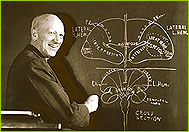
Every neuroscience undergraduate learns about the Penfield map, a correspondence between locations on the stripe across the middle of the top of the brain (somatosensory cortex) to a sequence of locations on the body. This map was discovered by Wilder Penfield in the course of applying electrical stimulation to the brains of hundreds of epilepsy patients he was treating. The size of each area on the map corresponds to the degree of sensitivity we have in that area: areas for the tongue, or the hands, for example, are proportionally larger.

An odd aspect of the map is its placement of the human genitals right next to the feet. This is believed to account for the bizarre phenomenon that people with amputated feet feel orgasms in their phantom foot. It may also lie behind foot fetishes.

My theory is that the Penfield map is related to desirable sitting positions for meditation. In other words, meditation is more effective if body parts which are mapped to nearby brain areas are brought together physically—such as bringing the feet near the genitals in the full-lotus position. The fingers are brought together directly below the eyes, which they are positioned next to on the Penfield map.

Penfield was the exact opposite of a reductionist or physicalist. With his experience in electrical stimulation of the brain, he viewed the key question as: is there any electrical stimulation could make a patient decide or will or believe? His answer was no. He attributed these phenomena not to the brain, but to the “soul”.

Towards the end of his career, Penfield captured his thoughts on the neurological basis for the philosophical belief in the human soul in his book The Mystery of the Mind.

As an aside, Penfield was interested in bilingual children, and felt strongly that early exposure to a second language was highly beneficial to the child’s overall development.

Book Review: Soul Made Flesh

January 17th, 2005

Soul Made Flesh: The Discovery of the Brain—and How it Changed the World is Carl Zimmer’s panoramic tour of medicine, philosophy, and science in the 17th century, primarily in England, centering around Thomas Willis (portrait), known as the father of neurology.

A little too panoramic, perhaps. Too many people whiz by, not all of them that interesting. The ones we do care about—Hobbes, or Locke—fly by too quickly. Zimmer’s treatment of the historical and political context, while obviously necessary, seems rushed and incomplete. The book ends with a hurried tour of modern neuroscience, racing through fMRI, dopamine, emotions, and pathology—trying to tie these developments back to Willis.

What was striking to me was that, on the one hand, Willis was one of the first people to actually look at the brain scientifically; among other breakthroughs, he identified things called nerves. He documented his work relentlessly, and created beautiful atlases with his collaborators, including Christopher Wren. So why did he continue to stick to theories involving “spirits” and “vapors” throughout his life, in the absence of any empirical evidence that they might exist? Why did he continue to treat his patients (he was a practicing doctor) with leeches and odd concoctions, none of which apparently worked?

And how did Willis get so rich? Based on the descriptions in the book, it sounds like he was worth several tens of millions of today’s dollars. Sure, I know doctors make lots of money but how did he make that much?

Overall, though, this book is highly readable and immensely educational. Recommended to anyone interested in the history of medicine and the brain.

Course in Neurotheology at UF

January 17th, 2005

A new course at the University of Florida, Neurotheology: The Interface between the Brain and the Divine , may be the only university course in neurotheology taught anywhere in the world—does anyone know of others?
The course has been developed by Dr. Lou Ritz, an Associate Professor of Neuroscience at the university. According to his biography, his research interests are concerned with spinal cord injury and repair. One paper he’s written involves watching how cats balance themselves with their tails, then shows how breaking their tails (called sacrocaudal transection; ouch!) leads them to lose their balance and fall more often. He’s also a co-director of the Center for Spirituality and Health at UF.

From the syllabus:

Are religious and spiritual experiences brain-based? If they are, what are the implications to understanding brain circuitry? If they are not, what are the implications to our understanding of who we are? Our course – Neurotheology -will investigate the neural correlates of religious and spiritual experiences and the implications of such relationships.

Topics to be explored include: organization of higher cortical function in the human brain; effects of cortical brain lesions on our perception of reality; the variety of religious experiences; modern brain imaging; meditation and spiritual experiences; brain correlates of meditation; eastern and western views of the mind; how the brain constructs reality; attention and awareness; mind-body medicine; psychedelics and mystical experiences; the neurobiology of emotions; the God gene – the genetic basis of spiritual experiences.

I’d like to see the detailed syllabus for this course, including the reading materials. And it would be great if Dr. Ritz could turn the course into a book providing a balanced overview of the field—in spite of all that’s been written, such an overview still does not exist.

Did the Egyptians believe in an afterlife?

January 16th, 2005

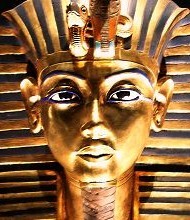
The King Tut Exhibition had its first stop in Los Angeles—and how could we possibly miss something like this?

And of course one of the first things the exhibit taught was how the ancient Egyptians believed in an afterlife and that all the stuff they put in the tomb was designed to help young Tut navigate that afterlife more successfully: boats to take him across the equivalent of the Styx, assistants, tools such as knives, you name it.

But what justification do we actually have in support of the concept that the Eqyptians believed in the afterlife? After all, there are many alternative explanations as to why they might have buried a king together with objects in this particular fashion. And parts of the theory are questionable. For instance, if the Egyptians had truly believed that their Pharaoh would be resurrected and enjoy an afterlife, why did they include models of objects instead of the real thing?

When my family’s beloved Shiba-ken “Wanda” was hit by a car and died, we placed her toys in with her in the box sent through the cremation line. We did not do so because we believed she would be playing with them in an afterlife. (Were there indeed an afterlife for dogs, such a miraculous phenomenon would certainly include all the toys Wanda could have wanted, ones much better than any we provided during her mortal existence.)

Just as we were doing with Wanda, my strong sense is that the Egyptians were honoring King Tut’s memory and revisiting and modeling his life through the decorations in the tomb.

evert

January 16th, 2005

To turn inside out or outward. This word was used in a NYT article describing a worm which burrows by “everting” its mouth into a kind of big drill bit.