Archive for the ‘los angeles’ Category

1656 West 25th Street: another house designed by S. Tilden Norton

Sunday, December 23rd, 2007

On December 1 we participated in the 21st Annual Holiday Home Tour & Progressive Dinner in Historic West Adams. Groups of 20-30 toured six classic houses, mostly on W. 25th.

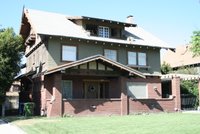
One house of particular interest was the Bernays Family Residence at 1656 West 25th Street, since it was designed by S. Tilden Norton, the architect that designed our house. The two houses share the American Foursquare/Colonial Revival style, and have many features in common such as the front attic gable and porch extending halfway across the front of the house to the right. And this house, like ours, was turned into a rooming house in the ’70s and ’80s, with up to 30 occupants, before being lovingly restored.


View Larger Map

Western Heights, the neighborhood to our west

Saturday, November 3rd, 2007

Western Heights is the neighborhood right to our west—bounded by Western on the east, Arlington on the west, Washington on the north, and I-10 on the south. When we were looking for a house we ran into this area, which contains some of the most fabulous, large-scale, sumptious century-old homes anywhere in LA.

(more…)

Bob and Sakiko’s New House (II)

Wednesday, October 10th, 2007

Last weekend we visited the Los Encinos Historic Park with Claire’s husband Robert. This park is all that remains of the grand Rancho Encino, owned starting in 1889 by Domingo Amestoy (picture), father of John B. Amestoy, the first owner of our new house.

(more…)

Kokekokko, Best Yakitori Restaurant in LA

Sunday, September 30th, 2007

Kokekokko is the best yakitori place in Los Angeles, and I’ve been to most. Here it’s all about the food. The first thing out were quail eggs, plump, slightly larger than usual, lightly charred. The “meatballs” (tsukune) were juicy and grilled to perfection. The moist tebasaki (wing) meat fell off the bones. “Toku-hatsu”, a fattier variety of hatsu (chicken heart), was a real revelation.

David Myers (no relation), chef at Sona, the restaurant near Bob’s old place in West Hollywood, has high praise for Kokekokko: “Old-school yakitori. They also serve chicken sashimi, from the breast and from the leg. It’s very soft, kind of like toro. It’s so smooth.”

Kokekokko is in Little Tokyo downtown. You’ll often find yourself waiting for a table, or waiting for your food once you’ve ordered. That’s OK. Wash down your sticks with some sake from their reasonably good list.

Bob and Sakiko’s New House

Thursday, September 27th, 2007

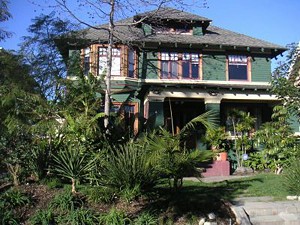
Bob and Sakiko’s new home is the Amestoy house, built in 1906 by John B. Amestoy (picture), member of a well-known pioneer family who owned the Rancho Encino in the San Fernando Valley, now the city of Encino.

The architect for the house was Samuel Tilden Norton, an early Jewish resident of LA, who designed a number of buildings across LA in the early 1900s, including the Greek Theatre.

The house is in the Colonial Revival style, specifically the “foursquare” variant, with a high-pitched roof, narrow clapboard siding, wood molding at the ceiling level throughout the house, and paneled front door.

An Assessor’s report from 1915 reports a single two-story residence with brick foundation, nine plumbing features, ornamental buffet, fireplace, and barn. The 3,285 sq. ft. structure included four living rooms and kitchen on the first floor and five bedrooms and bathroom on the second, with “three wooden floors”.

The house maintains its original floor plan as well as those original wooden floors, which although now refinished still bear the scars of decades of use, including a period as boarding house. It was extensively restored by Ed Sutton, the owner from 2000-2004, and the house is still known as “Ed’s House” by the locals.

The Amestoy house is located in the Harvard Heights neighborhood of LA on the hills southwest of downtown, near Western and Venice, and lies within the Harvard Heights Historical Preservation Overlay Zone (HPOZ), just south of Koreatown. Originally a middle-class streetcar suburb with a Greek flavor, the area evolved a more inner-city character after the War. Starting in the 90s a gradual gentrification process began; this block of S. Hobart Blvd. is now sprinkled with well-restored houses, the Amestoy house among them.
Complete Mendelssohn organ works in Pasadena

Monday, June 26th, 2006

This picture shows the Aeolian-Skinner organ at the Pasadena Presbyterian Church, the site of a program featuring nine organists performing the complete organ works of Mendelssohn on Sunday, June 25, 2006.

Mendelssohn lived to only 39, dying in 1847 after a series of strokes. The world would be much poorer without the brilliant set of sonatas he had completed just two years earlier—arguably the most powerful, lush, compelling works in the entire organ oeuvre.

An interesting feature of the PPC organ is the so-called “Echo organ” of 14 ranks in the rear of the church. Such multiple-organ setups often work less than ideally, but is an absolutely perfect fit here, especially for Mendelssohn’s favored loud/soft counterpoints, in the first and other sonatas.

Matsuhisa

Monday, December 26th, 2005

Matsuhisa is Nobu’s sushi place on La Cienega in LA. Notice that I say “place”, not “restaurant”, because the word “restaurant” calls forth a very specific semantic matrix, where the focus is entirely on the food. Think of Iron Chef USA; the chefs are rated on Taste, Presentation, and Creativity. The food must dazzle, it must amaze. It’s performance art on your plate. Look at how Wolfgang has stacked those beets into a tower! Yes, that’s worth $200! It’s food as sex, the meal as fellatio of a particularly imaginative variety.

Good sushi, in contrast, like the inner lining of a silk kimono never revealed to the outside world, excels precisely to the extent it actively fails to assert itself. One enters the sanctum; experience unfolds; time unwinds; conversation ensues; libations lubricate; sushi materializes.

Matushisa is, very simply, the best sushi place in LA. It tries only to be a sushi place, and succeeds beyond all expectations. The excellence of the experience is in the detail. The ultimate simple piece of finely marbled toro rests on an otherwise unadorned clump of vinegared rise. The chef sequences the food you are served perfectly. The waiter discreeetly replaces one soy sauce dish with another between courses.

I must congratulate Nobu on his choice of Hokusetsu (“north snow”) sake, one of the finest jizake in Japan, one seen all too rarely at other restaurants.

Of course Nobu is creative. The yellowtail with jalapeno dish he originated has now been stolen by every sushi shop worth its gari. His modestly named “new style sushi” takes fresh fish flesh and cooks it briefly and deliciously in hot sesame oil. But these dishes both tell us something about the food we are eating, rather than simply being gratuitously “creative”.

All of this excellence comes at an amazingly reasonable price, far from the bloated $500/person tab at places like Masa, and possibly even less than you would pay in Japan for an equivalent, or inferior, sushi experience.

Sushi 90069

Thursday, December 22nd, 2005

If neurotheology’s basic premise holds water, then a healthy brain is essential to a healthy spirit. And what better food to feed the brain than sushi, that quintessential Japanese classic, marrying the fruits of the sea and the rice paddy? Besides, it tastes good.

It helps that West Hollywood, our home, may have the highest concentration of sushi restaurants anywhere in the world—many within walking distance for us.

The sushi-ya closest to us, a mere three-minute walk, right across from the towering Pacific Design Center, is Nishimura, which I reported on here five years ago. This is the best sushi restaurant on the West Coast, or possibly in the US. Unfortunately, I can’t give you any recommendations for what’s best here, since Nishimura-san will decide that for you on any given day, piecing together ultra-creative, mouth-watering dishes from the supremely fresh neta he flies in from Japan. The problem is that a once-a-week meal here would consume a huge portion of my disposable income.

Down La Cienega we find Yabu (website), where it’s hard to go wrong with their competent sushi, good jizake collection, reasonable ambience, and dishes such as the Osaka-style pressed sushi which we love. Yabu also boasts a good soba menu, if you’re in that kind of mood.

As of late November, 2005, our all-time favorite, Murakami, right down at the end of our street on Santa Monica, where we had spent many an enjoyable evening bantering with the master and wolfing down his imaginative concoctions, has been sold to a new chef/owner. A recent visit demonstrated that all is not well at our favorite Japanese sushi shop. The old Murakami ambience is completely gone. The entire wait staff is new, and very shaky. The service has now slowed down by a factor of two. It may be my imagination, but the fish itself—possibly the single aspect the chef/owner is most responsible for, on his daily buying trips—is of lower quality. The lovely flower arrangements the previous owner’s wife did are gone—replaced by a cold, barren wall. Murakami-san took with him not only the spirit of the restaurant, but also its name; it now goes by the undistinguished moniker “Ari-ya”.

A bit west on Santa Monica we find Ajisai, just up Palm, where chef Shoei presides over his tiny fresh fish empire, with friendly service, superb catches of the day, background jazz, and good conversation. Our favorite is the boiled squid stuffed with crab.

Down Beverly is Hirozen, also reviewed in this space last year. Although you can eat à la carte, you cannot go wrong with Hiro’s omakase chef’s selection. Highly recommended.

North of Santa Monica on La Cienega we find Wa Sushi & Bistro, the subject of considerable oohing and aahing in the local press when it opened last year, possibly because its chefs are graduates of the legendary Matushisa just a few blocks away. But we found the food overwrought, the service spotty. The albacore salad we had was drenched in an overly assertive miso sauce. They can’t just serve sea bass—it has to have foie gras on top. They can’t just serve soft-shelled crab—it has to have caviar on top. Price performance is poor. We won’t be visiting this place again soon.

The king of 90069 sushi places, of course, is the iconic Sushi Roku, down on 3rd just off La Cienega. It’s also a celebrity hangout; once I saw David Spade there, a fine actor, although I didn’t get the chance to tell him how much I liked him in Joe Dirt. Sushi Roku has long outlived its never justified reputation. Service is perfunctory. The only thing high-end about it is its prices.

Koi (website) also made a big splash when it opened last year right near us on La Cienega across from L’Orangerie. This is definitely the place to go if you want to try “hamachi fusion soy citrus truffle essence” or “yellowtail carpaccio grapeseed oil and ponzu wasabi tobiko”, consumed in a space that boasts of being a “stylish, harmonious blend of of custom furniture, earth tones and soft light”. Of course, it’s not really a sushi place, instead its cuisine is “Japanese-inspired with California accents”. Its cavernous interior seats over 200 aspiring movie moguls and 20-something would-be models.

Given all the sushi joints in LA, one wonders why anyone with no sushi-making skills and not even from Japan would even bother trying the genre, but still there are those that do. One we recently had the misfortune of trying was Niko Niko Sushi, right next to Barney’s Beanery, famous as Janis Joplin’s favorite hangout when she lived down the street. Suffice it to say you’d be better off crossing the street to IHOP and getting their $2.99 pancake special.

Of course there are lots of sushi places up on Sunset which I make a point of never patronizing. They can’t decide whether they want to be overpriced tourist traps or starlet-encrusted sushi discos. However, Katana is worth a mention, and a visit. Although definitely awash in Hollywood glitter, and owned by the Sushi Roku crowd, it serves a reasonable menu of kushi—things on sticks, one of mankind’s most basic food formats. I like the stuffed mushrooms and rib-eye, and the lamb is worth a try. I wouldn’t recommend their sushi, though.

The granddaddy of upscale nouvelle cuisine Japonaise à la mer is, of course, Matsuhisa itself, on restaurant row on La Cienega. I’ll regale you with Matushisa stories in another post.

Hirozen, Japanese Restaurant Extraordinaire

Friday, December 24th, 2004

Hirozen is the little Japanese spot in a strip mall at Orlando and Beverly in West Hollywood, a five-minute drive from our house. Although it was once one of our favorites (I even talked them out of a Hirozen shirt which I still have), inexplicably we hadn’t visited them for probably two full years until our visit last night.

Hiroji Ohbayashi, the owner and chef, has been busy innovating and creating and—still—cooking, as he was last night. The Today’s Special menu is a cornucopia of old and new favorites, brilliantly walking the line between traditional and modern. We’ve always loved the sweetish Nasu Soboro (Eggplant with Ground Chicken), a simple old Japanese pub dish that Hirozen does gloriously; Bob thinks it’s just the right thing to go with sake. Zucchini Flower Tempura is a deserved favorite.

At the table next to us sat a beautiful lacquered black platter with luscious broiled chicken pieces, a tower of tempura, and elegant mounds of hijiki and Japanese potato salad. I discreetly asked the waitress what that was and nearly fell off my chair when she told me it was the “teriyaku tempura combo plate”. Only Hiro could take the tired old stereotyped combination plate from Japanese restaurants in the 60s and update it this vigorously and sophisticatedly and humorously. I spent so much time gazing longingly at it that I almost forgot to ogle the would-be starlet picking it at with her studio executive boyfriend. Seized by a sudden craving for the hijiki and potato salad, I strong-armed the waitress into bringing me a small sample.

Lately we’re stuck on sashimi platters whenever we eat Japanese and here we went for a simple plate of striped bass, kampachi, and aoyagi, which was presented perfectly and was astonishingly fresh. We also had the shiitake stuffed with grilled tuna, a festival of contrasting flavors and textures, your Japanese izakaya staple “ika natto”, and another old favorite, crab meat chile relleno with salsa. We washed this all down with some perfectly serviceable warm sake. It’s winter, after all.

I hear that Hiro is spending time consulting for Japanese restaurants opening up in Las Vegas and elsewhere. That’s great for them and him, but I sure hope he doesn’t stop innovating and cooking great food at his fine little ten-table restaurant, without doubt one of the finest Japanese eateries in our beloved city of angels.

The very earth on which we stand is crumbling

Sunday, October 31st, 2004

More excitement than ever now around West Hollywood: now we have our very own earthquake! This one woke us up.