
Archive for the ‘history and culture’ Category

Hofstadter and the Singularity

Monday, June 16th, 2008

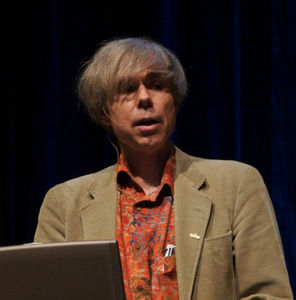
I got a copy of Douglas Hofstadter’s “I Am a Strange Loop” (Amazon) for my birthday and spent the next month puzzling over why this inane book ever got written, other than to make a few bucks from aging technohippies with fond memories of Godel, Escher and Bach. It’s basically a random collection of unstructured jottings, boring personal stories, and contentless musings. Try as he might, Hofstadter never manages to convince us of the connection between Godel’s proof and some kind of loop that supposedly lies at the basis of our consciousness. Oddly, there’s almost no reference to any of the actual research in neuroscience or related fields which has started to cast light on the phenomenon of consciousness in recent years.

Hofstadter’s treatment of Zen in the book is emblematic of its problems. In a dialog between “Strange Loop #641″, a believer in the ideas of I Am a Strange Loop (such as they are), and “Strange Loop #642″, a doubter, he has them saying: (more…)

Crime, Punishment, and the Singularity

Wednesday, May 28th, 2008

Another interesting social issue related to the Singularity is its effect on our penal system, especially the millions of folks we’ve got locked up right now. Take a prisoner with a 50-year sentence. If he has to serve his entire sentence he wouldn’t be out until 2050, but by that time we expect inconceivable advances in genetics, nanotechnology, and artificial intelligence/robotics, all of which could have implications for his case. (more…)

The Singularity is Near

Monday, May 26th, 2008

Ray Kurzweil’s The Singularity is Near (Amazon) is one of those books that really changes the way you look at things.

For instance, when the Supreme Court rules on virtual child porn as it did recently (SCOTUS Wiki), you see that the real issue goes far beyond Photoshopping some kidpix. (more…)

Getting guidance for your life from the web

Monday, January 21st, 2008

A recent college graduate I know recently found himself most unhappy in his new job. But was there something really wrong with the company he had had such high hopes for, or was it merely a case of the freshman blues? Where to turn for advice? Friends? Parents? Professors?

(more…)

Bob and Sakiko’s New House (II)

Wednesday, October 10th, 2007

Last weekend we visited the Los Encinos Historic Park with Claire’s husband Robert. This park is all that remains of the grand Rancho Encino, owned starting in 1889 by Domingo Amestoy (picture), father of John B. Amestoy, the first owner of our new house.

(more…)

The Predator Delusion

Sunday, October 1st, 2006

A day when a French writer has been threatened with death for writing that Islam harbors violent tendencies seems appropriate for considering the role played in the propagation of destructive and divisive religous beliefs by the indoctrination of unwilling children.

This is a point that Richard Dawkins makes at great length in his new book The God Delusion, which I’ll have more to say about later from the neurotheological perspective. What interests me here is the connection Dawkins makes between the religious abuse (my term) of children and sexual abuse. His point is that, of the two, religious abuse—scaring children with stories of hell, to name just one example—does more profound damage than sexual abuse. He goes so far as to call the current preoccupation with child sex abuse “hysterical” and to compare it with the Salem witch trials.

Hear hear. As I write this, NBC is running a series on its Dateline “news program” called To Catch a Predator, where an on-line decoy posing as a 14-year-old girl, perhaps, entraps foolish men by offering sex if they come to her house where she will be alone. The level of the scam rises to the decoy reminding the victim to bring condoms and liquor. When the clueless prey actually show up at the house, they are met by a reporter who reads back to them their crude chat room dialog and asks them if they really intended to have sex with a 14-year-old. On leaving the house, the men are thrown to the ground by waiting local police and hauled dramatically off to the police station. This scenario is repeated, with very little variation other than the age and profession of the target of the sting, a dozen times in one program. At the end of the program, experts solemnly aver what a grave danger has been averted by capturing these vicious predators before they could harm innocent children.

Try again, NBC. Given what losers these guys are, the chances they would have ever actually done anything without being actively set up are nil. If they have enough money to get a good lawyer, which they probably don’t exactly because they are such losers, they should be free in a heartbeat. Can you really be convicted of corrupting the morals of a minor when the minor is not a minor or doesn’t exist at all? All this program does is show how stupid the network, the audience, and the entrapped men all are. (See a critique from the journalistic perspective.)

Right here in California a proposal to crack down hard on these disgusting perverts, the so-called Jessica’s Law, Proposition 83, will be on the ballot in November. Reportedly over 80% of the voting public are in favor of this. It’s being compared to the Three Strikes Law—a great success which allowed prosecutors to put a man in jail for 50 years for stealing some videotapes (the Supreme Court said that was not cruel and unusual punishment).

The proposal is massive draconian overkill. It makes a mockery of due process by allowing people to be kept incarcerated—not in a jail, of course, but a “hospital”—after they complete their sentence, simply on based on the opinion of a psychiatrist, with no appeal process. It brings many more offenses, including misdemeanors, or boys having sex with their girlfriends, into the metastatizing sexual predator frenzy. It will be expensive, not least due to the requirement for all sex offenders to wear ankle bracelets for the rest of their lives. It will crowd the jails with minor offenders. The residential restrictions will drive the offenders away from populated areas with police and counseling facilities. The entire premise—that sex offenders lurk in bushes then jump out to rape and kill our children—is false.

To its credit, the Sacramento Bee came down against this ineffective initiative:

Sex offenders who prey on children are every parent’s nightmare, and understandably so. Unfortunately, the fear they evoke makes them the bogeyman of choice for pandering politicians. What better targets for candidates in search of an easy issue to demagogue? Proposition 83 is a case in point. Despite Proposition 83’s title—the Sex Offenders, Sexually Violent Predators, Punishment, Residence Restrictions and Monitoring Initiative Statute—it would do nothing to protect children.

There is certainly a class of crimes that are despicable and reprehensible and need to be treated with the same severity as any other serious crime. However, a hallmark of the “debate” about juvenile sexual predation is to fail to make any distinction between such crimes and much less serious ones, or ones which should arguably not be crimes at all. It is no accident that this is the same society where a school teacher in Texas is fired for taking her class on a field trip to a museum which happens to include ancient statues with bare breasts or even dangling penises.

If sexual offenders are such evil incarnate, of such a uniquely perverse nature that they should be treated in a way completely different from regular criminals, let’s adopt unique approaches like not letting them of prison even after they’ve finished their time—just keep them locked up forever. Ooops—we’re already doing that in many places, and that’s one of the things Jessica’s laws wants to do. Well then, how about punishing them even before they offend, in a Minority Report sort of way? That’s already being done too, under an Ohio rule that allows judge to categorize people as sexual offenders, put them on the register, and subject them to all the relevant restrictions, even if there is merely a suspicion that they might have done something bad. The next step, which I’m sure somebody will propose soon enough, is to give the entire population MRIs to see if they’re interested in kids and throw them in jail right then and there.

If addition to the disproprortionality of the punishment to the crime in individual states, another problem is the gross inequity in sentencing levels from state to state. The exact same crime committed in one state could result in a sentence ten or more times longer than if committed in another. This hardly seems like the equal treatment under the law promised by the Consitution.

That we think of pedophiles in a frenzied horror, as opposed to say, murderers, who commit crimes every bit as heinous, is a reflection of our natural need for symbols of pure evil in our lives.

Cheryl Chase and intersex article in NYT

Sunday, September 24th, 2006

The NYT magazine has an extended article on Cheryl Chase, my friend and former business partner, and the incredibly important work she is doing on medical, cultural, and societal aspects of intersex, or ambiguous genitalia.

See also the website for the Intersex Society of North America.

Supremes OK getting high at church

Thursday, March 2nd, 2006

In the case of the Brazilian religious group wanting to import its hallucinogenic tea (prevous post on the topic), our nation’s top legal weenies have given the green light to tripping your brains out (opinion by Chief Justice John Roberts), as long as it’s sacramental and circumscribed. I doubt if the likes of Scalia or Thomas are really into the whole cleansing the doors of perception stuff, but hey, Congress has said people have the right to practice their religions (Religious Freedom Restoration Act), and that includes Indians using peyote.

Not an Indian? Not to worry. Courts have ruled that even white people can “join”.

The Dalai Lama has also come out in favor of bioenlightenment, even volunteering to go first if scientists come up with a happiness module they can implant in your brain. But most Buddhist teachers would emphasis the precept against taking things that lead to intoxication or heedlessness. To me, though, it seems that the “heedlessness” part indicates the whole precept is focused on alcohol.

It probably couldn’t have been a proscription against hallucinogenic plants, because, for whatever reasons of botanical fate, Asia, where Buddhism developed, has very few such plants. One exception is the powerful datura (Wikipedia) plant from the nightshade family, which has narcotic qualities and is known in India as “dutra” or “dhatura”. Some ancient Chinese writings are believed to refer to this drug, which apparently was held sacred in that country, where people believed that when Buddha preached, heaven sprinkled the plant with dew.

In addition, some theorize this may be the plant which when burned produced the intoxicating vapors of the Oracle of Delphi.

Actually, the latest theory about the Oracle of Delphi, set out by William J. Broad in his recent book “The Oracle: The Lost Secrets and Hidden Mesage of Ancient Delphi” (Amazon), is that unique geological structures under the shrine produced a mist of potent, trance-inducing gases.

In an article in the NYT science section on 2006-02-28, entitled “The Oracle Suggests a Truce Between Science and Relgion’, Broad claims that the approach of scientists involved in the discovery represented an important paradigm for the coexistence of science and religion:

[The scientists] claimed no insights into how her utterances stood for ages as monuments of wisdom. They had no explanation for how the priestess inspired Socrates, or the seeming reliability of her visionary pronouncements. In short, the scientists, while solving a major riddle of antiquity, wisely left other mysteries untouched.

This seems very confused. The scientists did not “leave other mysteries untouched” out of some muddled belief in overlapping magisteria, but because they were archaeologists and geologists trying to find the famous chasm under the shrine. If they had been neurobiologists then they should and would have studied the physiological and behavioral effects of inhaling limestone fumes.

Religion and societal collapse

Tuesday, February 14th, 2006

Jared Diamond (picture, Wikipedia entry) has written Collapse, a book about how societies fail, following on the heels of his previous Guns, Germs and Steel, which addressed the other side of the same question—why some societies succeeded. (That book, by the way, has a great section on the Incan empire and its defeat by the conquistadors.)

My interest is in how religion relates to a society’s success or failure. Unfortunately in “Collapse” Diamond deals with this question only tangentially. The examples he gives, however, do not speak well for religion. For instance, he attributes much of the blame for the collapse of the Norse society which existed in Greenland during the first half of the last millennium to the overinvestment in Christian infrastructure: the building of large churches, the undertaking of dangerous expeditions to acquire walrus tusk to trade for religious ornamentation. Similarly, the death of the civilization on Easter Island can also be attributed to religious factors, at least to the extent the motivation for building the huge stone statues was religious in nature. Building the statues consumed huge amounts of manpower and natural resources. In contrast, the societies he presents as relatively successful—including Tokugawa-era Japan, which he praises for its forestry policies—had weak religious infrastructures.

At the same time, it’s worthy of note that none of the societies Diamond identifies as political and environmental disasters are Buddhist.

Overall, “Collapse” is a worthy successor to “Guns, Germs and Steel”, although it tends to bog down in places. The focus is overwhelmingly on ecological/environmental issues, which account for three of the five causes Diamond identifies for societies collapsing:

  1. environmental damage
  2. climate change
  3. hostile neighbors
  4. friendly trade partners
  5. society’s response to environmental problems

Fine, but in his conclusions—basically, that the world faces an environmental crisis that threatens its collapse, albeit one that he bravely claims we can deal with—he entirely ignores his third factor, hostile neighbors, which would seem to be of prime importance given the current wave of global terrorism. He mentions terrorism of course, but only in the context that environmental depradations and the ensuing poverty can give rise to it. But the Saudis who flew airplanes into buildings suffered from neither.

Concerning his fifth point, society’s response to environmental problems, Diamond does mention political and organizational factors in the form of e.g. NGOs working to conserve natural resources, but, oddly, fails to address how a country’s political system affects its response (other than mentioning how poorly the USSR did environmentally). He does praise the conservation policies of noted autocrat Balaguer in the Dominican Republic, but fails to ask the obvious question: to what extent is democracy the best political system for dealing with environmental issues? Presented with a potential choice between some political prisoners rotting in jails and environmental devastation destroying a society, which would you choose? And of course Diamond talks at length about the impact of overpopulation on the environment, but fails to address how either it, or technology which allows information to be transmitted instantaneously and virtual groups to be formed overnight, affect the political and decision-making dynamic.

The elephant in the room, of course, is the impact of race. “Guns, Germs and Steel” went to great lengths, to the extent it can almost be read as an anti-racism manifesto. to make the point that Europe did not succeed because the Caucasians there were smarter than, say, native Americans, but rather because of factors such as flora, fauna, and geography. In “Collapse”, we are similarly told that Haiti is a failed country not due to any lack of giftedness on the part of its citizens but rather as a result of colonial history, climate, and the like.

But as the world becomes flat, in Thomas Friedman’s term, and globalization continues its inexorable progress, with people, information, products, resources, and money flowing like water across borders, making historical and geographical factors less important than ever before, what are the remaining factors that will dictate a country’s success?

The end of history

Monday, February 6th, 2006

Zen master Gudo Nishijima (pictured) believes in a world government run by the US military (post).

I can’t tell you how often I’m tempted to write about politics in this blog. I always try to resist that temptation—after all, there are people with much more insightful things to say on such topics than I. With his recent post, however, Nishijima-sensei has given me an opening I could drive a truck through.

Musing on where we find ourselves in the cosmological sense—sitting here on the third planet from the sun—Nishijima hits on the topic of the Cold War, and its remarkable, peaceful conclusion. But his thinking then takes an unexpected leap:

…what I feel so grateful for, is the fact that the USA and USSR reconciled with each other without fighting World War 3 in 1991. Before the reconciliation I could never have expected such a so happy reconciliation of the two countries at all. At that time I thought that, if World War 3 had occured, major parts of the surface of the Earth could have been destroyed easily…therefore it was such a thankful fact that because of the enormous efforts of the USA and USSR World War 3 has been avoided. We could become very joyful in such happy conditions wholeheartedly, we can enjoy so enormously that we, human beings, were not so stupid as to destroy ourselves with the atom bombs which we, human beings, had produced after so long and so eormous efforts.

Gosh. It’s true that we would have had a hard time enjoying ourselves, wholeheartedly or otherwise, if we had been vaporized in a mushroom cloud, but the mere fact of that not having happened does not, alas, suffice to give me “enormous joy”.

I have a rather peculiar idea on human history, that the world history of human beings seems to be similar to a sports tournament of some kind.

Not peculiar at all. Entire schools of thought and professional careers have been based on this idea.

And thinking about the real situation of the world, we can think that the Final Game of the World Tournament has ended without fighting, already. And I guess that the Winner of the Final Game might be USA.

This is a remarkable short-sighted and uninformed viewpoint, which just demonstrates that Zen masters probably shouldn’t be providing us with their political views.

First, there is no “final game”. I’m surprised that an advanced practitioner of Zen would speak in such apocalyptic terms. Dogen himself said in Bendowa that those talking about the “final” period were wrong. The US simply happens to have emerged as the strongest nation at this particular point in time, due to the convergence of a number of historical and economic factors.

But the US has not just won, says Nishijima; it will transmogrify into a world government!

Therefore in such a situation, USA has the possibility to change her Army into the Police of the World, and All Countries in the World will have the possibility to change their Armies into Branch Offices of the World Police. In other words I think that we, Human Beings, are able to begin to have the possibility of establishing the Government of the Whole World.

OK, but only if Donald Rumsfeld can be World Emperor too.

Seriously, America has no idea how to deploy its strength for good in the world. We’ve seen what happens when it tries to be the global policeman. Luckily, other countries won’t even consider changing their armies into “branch offices” of the US military. Long before that happens, the US military itself will implode, as it is already starting to; the US will be unable to continue to support it; and your “global winner” will finally begin to reap the fruits of years of incompetent management (especially during the last five years), neglect, and carelessness as it spirals down the drain economically, ethically, and spiritually.

[Note: Quotes from Nishijima’s blog have been edited for grammar and spelling without changing their meaning.]