
Thanks for your comments
Wednesday, January 18th, 2006  I’d like to thank the readers of Numenware for their insightful comments and the value they add to the blog.
Actually, the greatest number of comments came on an obscure post about a trivial English grammar issue. For some reason, huge numbers of readers from India believed I was offering some kind of English lessons. I wish I could figure out how to monetize these guys!
Next most popular was 34 readers commenting on my post about Charles Shaw’s $2 wine. Must have gotten picked up somewhere. As long as they click on my Google ads, I’m fine.
My post on sushi restaurants near my house generated 24 comments. My favorite was
My two interests are Neurotheology and Sushi and those two roads have guided me to this informative website….
Thought-provoking comments included those on the article Science and Buddhism on craving and suffering and The End of Faith. On my post on Bill O’Reilly: unlikely neurotheology advocate , the actual interviewee who appeared on Bill’s program made a comment. Some of the comments were very personal: on Religious music in your brain, one reader commented:
I am constantly hearing Christmas and religious hymns whenever I am not concentrating on a task. I also hear some old popular songs ‘Tammy’ & “The Bells of St. Mary’s”, “Star Spangled Banner” Every tune is in the same beat of 3/4 time. How do I stop this, it is driving me mad.
No one bothered to comment on one of my favorite posts, God and the brain in your gut, although it got some trackbacks. Nor on Peak experiences on mountain peaks , although it got picked up by Mind Hacks, nor on the article about dried squid entrails. My post about Sanyo: washing machines and global symbiosis yielded a request for a user’s manual for one of their washing machines.
The longest comment, by far, was on my post Book review: Living with the Devil , where Nordron, a Buddhist monk from Dharmasala, gave a thoughtful, detailed Buddhist perspective. Rhawn Joseph himself commented on my post about him and warned me that the picture I was using was wrong (since fixed).
I have been blessed with thoughtful, informative comments which add, I think, to the overall value of the blog, and not too many of them to be overwhelming. Thank you again.
 Can our brain sense that it is going to be able to recall something before it actually does?
 I’d like to introduce Numenware readers to the
  What is the relationship between music and the brain? A leading theoretician on that topic was Dr. Gordon Shaw (left), who died last month, and was most famous for discovering the so-called
 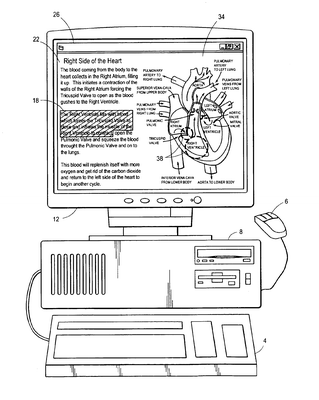 In addition to my many other hats, I’m an inventor. For a bit of year-end diversion, here are three inventions from this year:
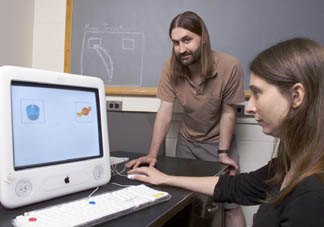 Michael Spivey (pictured) and his collaborators at Cornell did a cute little study, where they tracked the movement of the subject’s mouse as they tried to move it toward a picture on the computer screen corresponding to the word they had just heard. When the two pictures were of items whose lexical representations are “close” (think “candy” vs. “candle”) the mouse darted tentatively toward one before converging on the correct one. As the authors say in the
  Today let me introduce you to some neuroscience resources I’ve found useful.